
Access Modifiers (Encapsulation) in PHP OOP
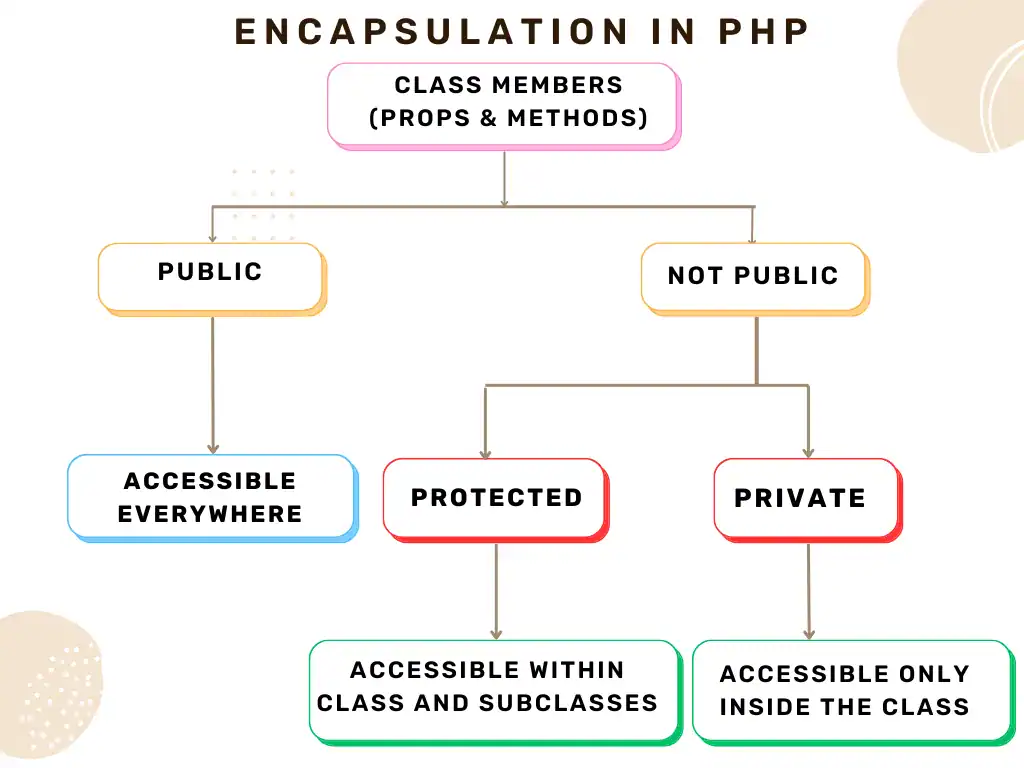
The wrapping up of data and methods into a single unit (called class) is known as encapsulation.
Encapsulation is a protection mechanism for the data members and methods present inside the class. In the encapsulation technique, we restrict data members from access to outside world end-user.
What Are Access Modifiers?
Access Modifiers define the visibility of class properties and methods. PHP provides three types of access modifiers:
- Public: Accessible from anywhere (inside and outside the class).
- Protected: Accessible only within the class and by derived (child) classes.
- Private: Accessible only within the class where it is declared.
Let’s explore each of these in detail with examples.
1. Public Access Modifier
A property or method declared as public can be accessed from anywhere.
Example:
class Car {
    public $brand;

    public function setBrand($brand) {
        $this->brand = $brand;
    }
}

$car = new Car();
$car->brand = "Toyota"; // Accessible outside the class
$car->setBrand("Honda"); // Accessible outside the class

echo $car->brand; // Output: Honda
Here, the $brand property and setBrand() method are public, so they can be accessed and modified directly.
2. Protected Access Modifier
A protected property or method can only be accessed within the class itself and in derived (child) classes.
Example:
class Vehicle {
    protected $type;

    protected function setType($type) {
        $this->type = $type;
    }
}

class Bike extends Vehicle {
    public function setBikeType($type) {
        $this->setType($type); // Accessible inside derived class
    }
}

$bike = new Bike();
$bike->setBikeType("Sports"); // Allowed

// $bike->setType("Sports"); // Error: Cannot access protected method
Here, $type and setType() are protected, so they cannot be accessed directly from an object but can be accessed within a child class.
3. Private Access Modifier
A private property or method can only be accessed within the class itself. It cannot be inherited or accessed from outside the class.
Example:
class User {
    private $password;

    public function setPassword($password) {
        $this->password = $password;
    }

    public function getPassword() {
        return $this->password; // Accessible within the class
    }
}

$user = new User();
$user->setPassword("secret");

// echo $user->password; // Error: Cannot access private property

echo $user->getPassword(); // Output: secret
Here, $password is private, meaning it can only be accessed through methods inside the class (setPassword() and getPassword()).
Using Getters and Setters (Encapsulation in Action)
Encapsulation ensures that object properties are not directly accessed. Instead, we use getter and setter methods to control how data is retrieved and modified.
Example:
class BankAccount {
    private $balance = 0;

    public function deposit($amount) {
        if ($amount > 0) {
            $this->balance += $amount;
        }
    }

    public function getBalance() {
        return $this->balance;
    }
}

$account = new BankAccount();
$account->deposit(500);

// echo $account->balance; // Error: Cannot access private property

echo "Balance: " . $account->getBalance(); // Output: Balance: 500
Here, balance is private, ensuring that it cannot be directly modified from outside. Instead, we use deposit() to add money and getBalance() to retrieve the balance.
Summary of Access Modifiers
| Modifier | Scope |
|---|---|
public | Accessible anywhere (inside & outside the class) |
protected | Accessible within the class and in derived classes |
private | Accessible only within the class where it is declared |
Encapsulation helps in maintaining data integrity and restricting unintended modifications, making your PHP code more secure, maintainable, and scalable.
Next Steps:
- Learn about abstract classes and interfaces in PHP OOP.
- Explore traits and static properties/methods.
- Implement real-world encapsulation in a Laravel application.
I hope this article helps you understand Access Modifiers and Encapsulation in PHP OOP. If you have any questions, feel free to comment below! 🚀