
Understanding Anonymous Functions in JavaScript
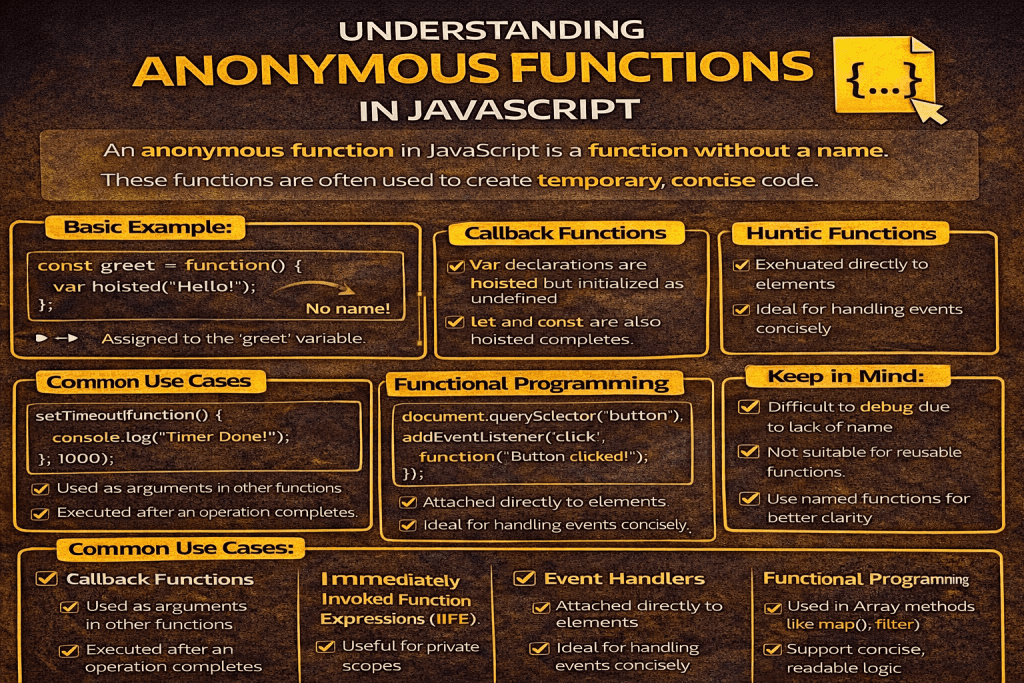
JavaScript is a versatile language known for its first-class functions. Among its many features, anonymous functions play a key role in modern development practices — from callbacks and event handling to promises and functional programming.
In this blog, we’ll explore what anonymous functions are, how to use them, their advantages and limitations, and answer some frequently asked questions.
An anonymous function is a function without a name.These functions are usually not accessible after their initial creation, and they are often used as arguments to other functions or assigned to variables.
// Anonymous function assigned to a variable
const greet = function() {
    console.log("Hello, world!");
};

greet(); // Output: Hello, world!🧠 Key Characteristics
- No identifier (name).
- Cannot be directly called unless assigned to a variable.
- Useful for callbacks, event handling, and functional programming.
- Can be anonymous arrow functions as well.
🧩 Use Cases for Anonymous Functions
1. Callback Functions
Anonymous functions are heavily used as callbacks.
setTimeout(function() {
    console.log("Executed after 1 second");
}, 1000);2. Array Methods
Array methods like .map(), .filter(), and .reduce() rely on anonymous functions.
const nums = [1, 2, 3];
const squared = nums.map(function(num) {
    return num * num;
});
console.log(squared); // [1, 4, 9]3. Event Listeners
Anonymous functions are used to handle DOM events.
document.getElementById("btn").addEventListener("click", function() {
    alert("Button clicked!");
});4. IIFE (Immediately Invoked Function Expression)
(function() {
    console.log("This runs immediately!");
})();5. Arrow Functions (ES6+)
const sum = (a, b) => a + b;
console.log(sum(5, 3)); // 8Arrow functions are typically anonymous and great for short, concise operations.
✅ Advantages of Anonymous Functions
1. Cleaner Code for Short Tasks
Great for short functions that don’t need a name or reuse.
setTimeout(() => console.log("Done"), 500);2. No Global Scope Pollution
Since the function isn’t named, it doesn’t pollute the global namespace.
3. Perfect for Inline Callbacks
When you only need the function as a one-time callback.
4. Helps with Functional Programming
Used widely in methods like .map(), .reduce(), etc.
5. Used in Closures
Helps create closures that capture variables from the outer scope.
❌ Limitations of Anonymous Functions
1. Harder to Debug
Without a name, stack traces can be vague and harder to read during debugging.
2. Not Reusable
You can’t call an anonymous function elsewhere unless assigned to a variable.
3. Reduced Readability
Chaining too many anonymous functions can make code hard to follow.
4. No Self-Reference by Default
You can’t call the function recursively unless it’s assigned to a variable.
🔄 Named vs Anonymous Functions
| Feature | Named Function | Anonymous Function |
|---|---|---|
| Has Name? | Yes | No |
| Reusable? | Yes | Only if assigned |
| Self-calling (recursion)? | Yes | Limited |
| Debugging? | Easier | Harder |
| Common Usage | Reuse, Recursion | Callbacks, One-time use |
Are anonymous functions the same as arrow functions?
Not exactly. Arrow functions are often anonymous but can also be named when assigned to a variable:
const add = (a, b) => a + b; // Named anonymous arrow function
Can an anonymous function be recursive?
Yes, but only if it’s assigned to a variable:
const factorial = function(n) {
return n <= 1 ? 1 : n * factorial(n – 1);
};
Why use an anonymous function instead of a named one?
Anonymous functions are ideal for:
1.One-time operations.
2.Functions used as arguments.
3.Keeping global scope clean.
Can anonymous functions access outer variables?
Yes. Like all functions in JavaScript, anonymous functions can form closures and access variables from their parent scope.
function outer() {
let count = 0;
return function() {
count++;
console.log(count);
};
}
const counter = outer();
counter(); // 1
counter(); // 2
Can I make an anonymous function async?
Absolutely.
const fetchData = async function() {
const res = await fetch(‘/api/data’);
const data = await res.json();
console.log(data);
};
fetchData();
📝 Conclusion
Anonymous functions are a cornerstone of modern JavaScript programming. They allow for more concise and readable code, especially in functional programming and asynchronous callbacks. However, like any tool, they should be used with care. Overuse can lead to debugging headaches and reduced clarity.
Use anonymous functions when:
- The function is small and only used once.
- You want to keep your namespace clean.
- You’re passing a callback to another function.
Avoid them when:
- The function needs recursion or reuse.
- Clear stack traces are critical for debugging.