
Master Array Sorting in PHP for DSA: Step-by-Step Guide with Examples
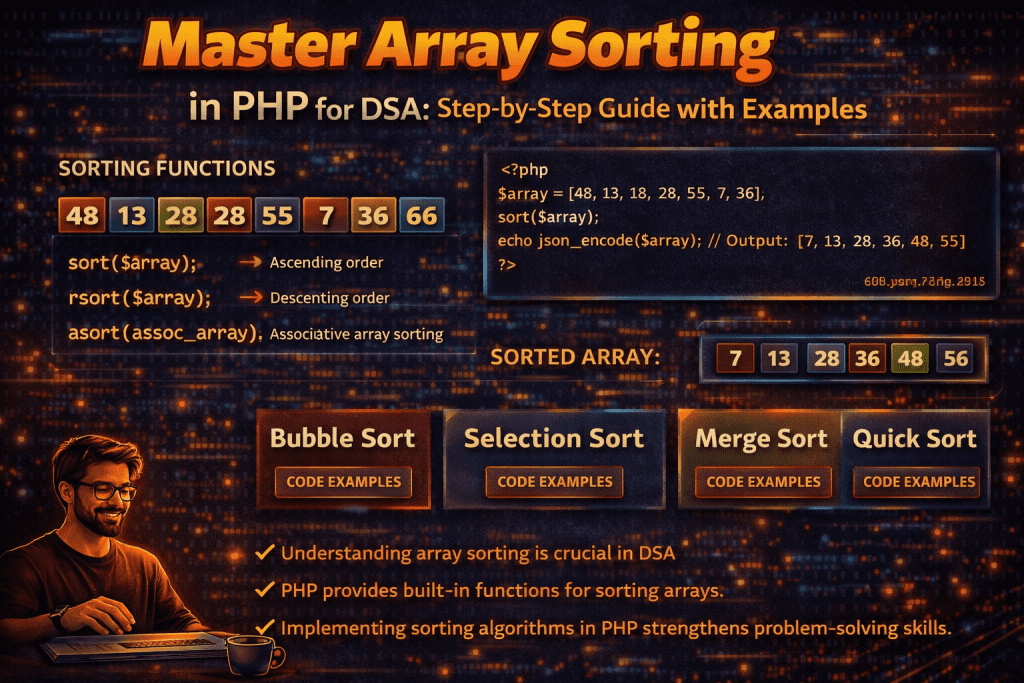
Sorting an array without using any PHP built-in functions is a common exercise in learning Data Structures and Algorithms (DSA). Let’s go through the main sorting algorithms and apply them manually to this sample array in PHP:
$arr = [5, 2, 9, 1, 5, 6];✅ Sorting Algorithms Covered
- Bubble Sort
- Selection Sort
- Insertion Sort
- Merge Sort
- Quick Sort
Then, we’ll discuss how to analyze time and space complexity.
1. 🔁 Bubble Sort (Basic, Easy)
Algorithm: Repeatedly swap adjacent elements if they are in the wrong order.
function bubbleSort(&$arr) {
    $n = count($arr);
    for ($i = 0; $i < $n - 1; $i++) {
        for ($j = 0; $j < $n - $i - 1; $j++) {
            if ($arr[$j] > $arr[$j + 1]) {
                // Swap
                $temp = $arr[$j];
                $arr[$j] = $arr[$j + 1];
                $arr[$j + 1] = $temp;
            }
        }
    }
}✅ Time Complexity:
- Worst:
O(n^2) - Best (already sorted):
O(n) - Average:
O(n^2)
✅ Space Complexity:O(1)
2. 🔎 Selection Sort
Algorithm: Repeatedly find the minimum element and put it at the beginning.
function selectionSort(&$arr) {
    $n = count($arr);
    for ($i = 0; $i < $n - 1; $i++) {
        $minIndex = $i;
        for ($j = $i + 1; $j < $n; $j++) {
            if ($arr[$j] < $arr[$minIndex]) {
                $minIndex = $j;
            }
        }
        // Swap
        $temp = $arr[$i];
        $arr[$i] = $arr[$minIndex];
        $arr[$minIndex] = $temp;
    }
}✅ Time Complexity: O(n^2) for all cases
✅ Space Complexity: O(1)
3. 📥 Insertion Sort
Algorithm: Build the sorted array one item at a time.
Insertion Sort builds the sorted array one item at a time by inserting each element into its correct position.
function insertionSort(&$arr) {
    $n = count($arr);
    for ($i = 1; $i < $n; $i++) {
        $key = $arr[$i];
        $j = $i - 1;
        while ($j >= 0 && $arr[$j] > $key) {
            $arr[$j + 1] = $arr[$j];
            $j--;
        }
        $arr[$j + 1] = $key;
    }
}✅ Time Complexity:
- Worst:
O(n^2) - Best:
O(n)(when already sorted)
✅ Space Complexity:O(1)
4. 🔀 Merge Sort (Efficient, Divide and Conquer)
Algorithm: Divide array into halves, sort and merge recursively.
Merge Sort is a divide and conquer algorithm. It divides the array into halves, sorts each half, and then merges them back together.
function mergeSort($arr) {
    if (count($arr) <= 1) return $arr;

    $mid = floor(count($arr) / 2);
    $left = array_slice($arr, 0, $mid);
    $right = array_slice($arr, $mid);

    $left = mergeSort($left);
    $right = mergeSort($right);

    return merge($left, $right);
}

function merge($left, $right) {
    $result = [];
    $i = $j = 0;

    while ($i < count($left) && $j < count($right)) {
        if ($left[$i] < $right[$j]) {
            $result[] = $left[$i++];
        } else {
            $result[] = $right[$j++];
        }
    }

    while ($i < count($left)) {
        $result[] = $left[$i++];
    }

    while ($j < count($right)) {
        $result[] = $right[$j++];
    }

    return $result;
}✅ Time Complexity: O(n log n)
✅ Space Complexity: O(n) (due to recursive calls and array merging)
5. ⚡ Quick Sort (Fastest in Practice)
Algorithm: Pick a pivot, partition array into sub-arrays, then sort recursively.
function quickSort($arr) {
    if (count($arr) < 2) return $arr;

    $pivot = $arr[0];
    $left = $right = [];

    for ($i = 1; $i < count($arr); $i++) {
        if ($arr[$i] < $pivot) {
            $left[] = $arr[$i];
        } else {
            $right[] = $arr[$i];
        }
    }

    return array_merge(quickSort($left), [$pivot], quickSort($right));
}✅ Time Complexity:
- Best / Average:
O(n log n) - Worst:
O(n^2)(if pivot is always min/max)
✅ Space Complexity:O(log n)toO(n)(depends on recursion depth)
🧠 How to Calculate Time and Space Complexity
Time Complexity
- Count loops:
- One loop = O(n)
- Nested loop = O(n^2)
- Recursive calls:
- Divide-and-conquer: Merge Sort and Quick Sort = O(n log n)
Space Complexity
- Memory used in addition to input array:
- Extra arrays (merge, quick): O(n)
- No new arrays (bubble, selection, insertion): O(1)
✅ Example Execution
$arr = [5, 2, 9, 1, 5, 6];

bubbleSort($arr); // or selectionSort, insertionSort etc.

print_r($arr);Result (sorted array):
Array ( [0] => 1 [1] => 2 [2] => 5 [3] => 5 [4] => 6 [5] => 9 )