
Lists, Tuples, Sets, and Dictionaries in Python
🔹 1. LISTS
✅ Definition:
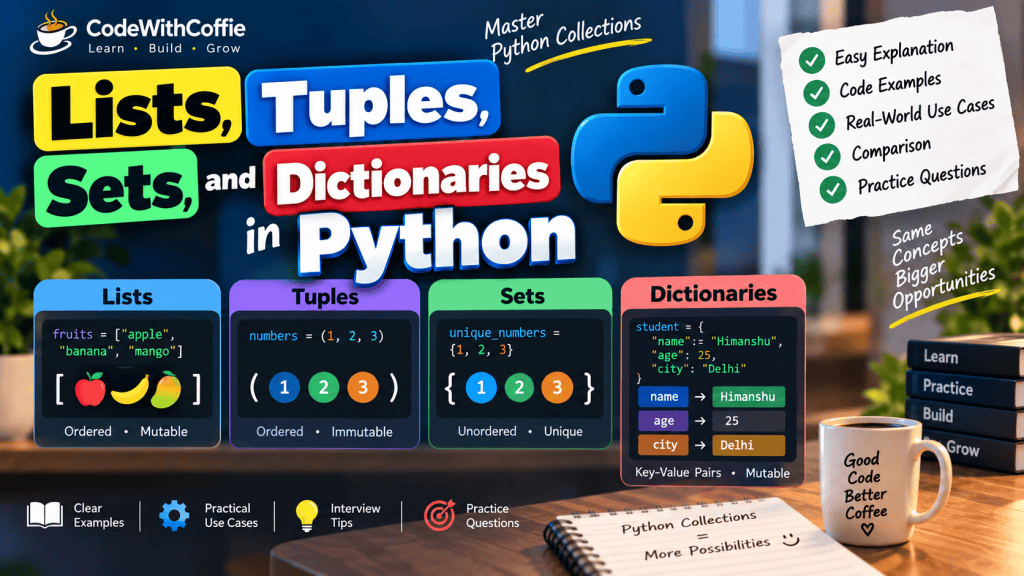
A list is an ordered, mutable (changeable) collection of elements.
✅ Syntax:
my_list = [1, 2, 3, 'apple', 4.5]✅ Characteristics:
- Ordered
- Mutable
- Allows duplicate values
- Can contain mixed data types
✅ Basic Operations:
fruits = ['apple', 'banana', 'cherry']

# Access elements
print(fruits[0])        # apple

# Update element
fruits[1] = 'mango'     # ['apple', 'mango', 'cherry']

# Append
fruits.append('orange')  # ['apple', 'mango', 'cherry', 'orange']

# Insert
fruits.insert(1, 'grape') # ['apple', 'grape', 'mango', 'cherry', 'orange']

# Remove
fruits.remove('cherry')   # ['apple', 'grape', 'mango', 'orange']

# Pop last item
fruits.pop()             # Removes 'orange'

# Length
len(fruits)

# Loop
for fruit in fruits:
print(fruit)🔹 2. TUPLES
✅ Definition:
A tuple is an ordered, immutable (unchangeable) collection.
✅ Syntax:
my_tuple = (1, 2, 3, 'apple', 4.5)✅ Characteristics:
- Ordered
- Immutable
- Allows duplicate values
- Can contain mixed data types
✅ Basic Operations:
colors = ('red', 'green', 'blue')

# Access elements
print(colors[1])       # green

# Count occurrences
colors.count('red')

# Index of element
colors.index('blue')

# Loop
for color in colors:
print(color)Tuples are used when you want data integrity (not modified accidentally).
🔹 3. SETS
✅ Definition:
A set is an unordered collection of unique elements.
✅ Syntax:
my_set = {1, 2, 3, 'apple'}✅ Characteristics:
- Unordered
- Mutable (but elements must be immutable)
- No duplicates allowed
✅ Basic Operations:
set1 = {1, 2, 3, 4}
set2 = {3, 4, 5, 6}

# Add
set1.add(5)

# Remove
set1.remove(2)

# Union
print(set1.union(set2))     # {1, 2, 3, 4, 5, 6}

# Intersection
print(set1.intersection(set2))  # {3, 4}

# Difference
print(set1.difference(set2))    # Elements only in set1

# Loop
for item in set1:
print(item)Sets are useful for removing duplicates and set operations.
🔹 4. DICTIONARIES
✅ Definition:
A dictionary is an unordered collection of key-value pairs.
✅ Syntax:
my_dict = {'name': 'Alice', 'age': 25, 'city': 'New York'}✅ Characteristics:
- Unordered (Python 3.6+ maintains insertion order)
- Keys must be unique and immutable
- Values can be any type
✅ Basic Operations:
person = {
    'name': 'John',
    'age': 30,
    'city': 'Mumbai'
}

# Access value
print(person['name'])       # John

# Update value
person['age'] = 35

# Add new key-value
person['profession'] = 'Engineer'

# Delete key
del person['city']

# Loop keys
for key in person:
    print(key, person[key])

# Loop items
for key, value in person.items():
    print(f"{key}: {value}")

# Get with default
print(person.get('salary', 'Not Available'))Dictionaries are perfect for structured data, JSON-like objects, and fast lookups.
🔹 Summary Table
| Feature | List | Tuple | Set | Dictionary |
|---|---|---|---|---|
| Ordered | ✅ | ✅ | ❌ | ✅ (3.7+) |
| Mutable | ✅ | ❌ | ✅ | ✅ |
| Duplicates | ✅ | ✅ | ❌ | Keys ❌, Values ✅ |
| Indexing | ✅ | ✅ | ❌ | Keys |
| Use Case | General data | Fixed data | Unique items | Key-Value data |
✅ Real-World Example
# Store student info with subjects
student = {
    'name': 'Ravi',
    'age': 21,
    'subjects': ['Math', 'Science'],
    'marks': {'Math': 90, 'Science': 85}
}

# Add subject
student['subjects'].append('English')

# Update marks
student['marks']['English'] = 88
No comments yet! You be the first to comment.