
Understanding the Scope Chain in JavaScript
Introduction
If you’ve ever written JavaScript, you’ve used variables — but have you ever wondered how JavaScript knows where to find them? The answer lies in the scope chain.
The scope chain is a fundamental concept in JavaScript that determines how and where variables are accessed during code execution. It’s part of JavaScript’s lexical scoping system and plays a big role in closures, callbacks, and debugging.
What is Scope?
In simple terms, scope is the set of variables that are accessible in a particular part of your code.
JavaScript has three main types of scope:
- Global Scope → Variables declared outside any function/block are available everywhere.
- Function Scope → Variables declared inside a function are accessible only within that function.
- Block Scope → Variables declared with
letorconstinside{}are accessible only inside that block.
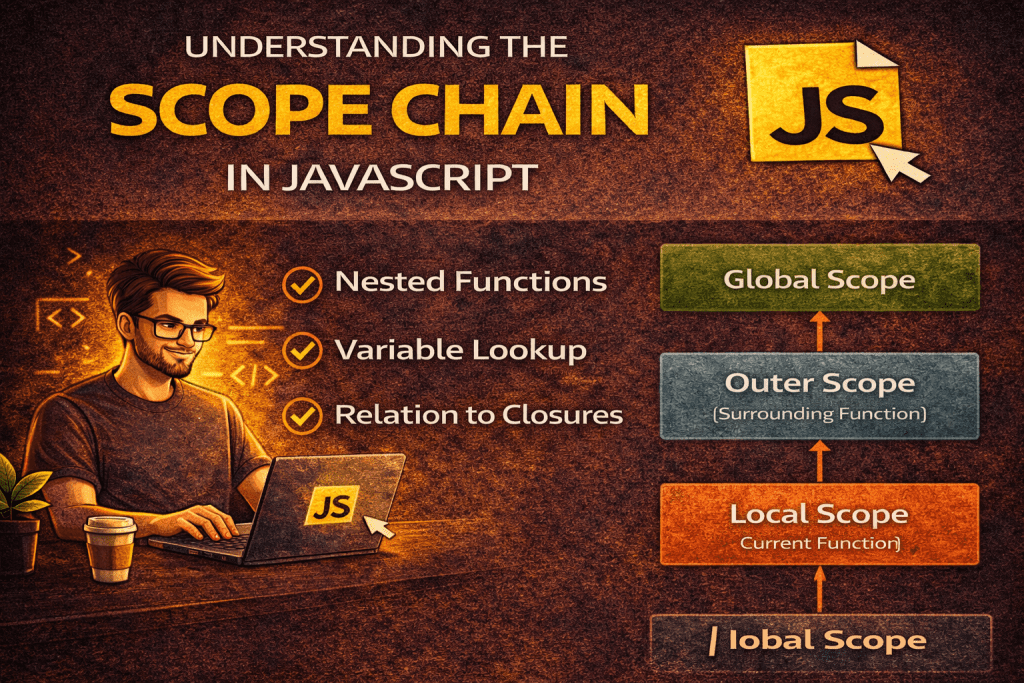
What is the Scope Chain?
When JavaScript needs the value of a variable, it starts looking:
- In the current function/block scope.
- If not found → moves to the outer scope.
- Keeps moving outward until it reaches the global scope.
- If not found anywhere → ReferenceError.
This chain of scopes from inner to outer is called the scope chain.
How Scope Chain Works (Step-by-Step)
Let’s take an example:
let globalVar = "I am global";

function outerFunction() {
    let outerVar = "I am from outer function";

    function innerFunction() {
        let innerVar = "I am from inner function";

        console.log(innerVar);   // Found in current scope
        console.log(outerVar);   // Not in current scope → found in outerFunction scope
        console.log(globalVar);  // Not in outerFunction scope → found in global scope
    }

    innerFunction();
}

outerFunction();
Process for console.log(outerVar) inside innerFunction():
- Looks in
innerFunction()scope → ❌ Not found. - Looks in
outerFunction()scope → ✅ Found (outerVar). - Stops searching.
Scope Chain Visualization
[ innerFunction scope ]
     innerVar = "I am from inner function"
         ↓
[ outerFunction scope ]
     outerVar = "I am from outer function"
         ↓
[ global scope ]
     globalVar = "I am global"
ReferenceError Example
If JavaScript can’t find the variable in the entire chain:
function test() {
    let a = 10;
    console.log(a); // ✅ Found
    console.log(b); // ❌ Not found anywhere → ReferenceError
}

test();
let b = 20; // Declared after function call
Lexical Scoping
JavaScript uses lexical scoping, meaning the scope chain is determined by where functions are written, not where they are called.
Example:
let x = 1;

function first() {
    let y = 2;
    function second() {
        console.log(x, y);
    }
    return second;
}

let myFunc = first();
myFunc(); // Output: 1 2
Even though myFunc is called outside first(), it remembers x and y because of the scope chain.
Real-World Use Case: Closures
The scope chain enables closures, allowing inner functions to access variables from their outer functions even after the outer function has finished executing.
function counter() {
    let count = 0;
    return function() {
        count++;
        return count;
    };
}

const myCounter = counter();
console.log(myCounter()); // 1
console.log(myCounter()); // 2
console.log(myCounter()); // 3
Here, count stays alive because the inner function keeps a reference to the outer scope.
Important Points to Remember
- Scope chain resolution is read-only — it can read variables but not rewrite the chain.
- Inner functions have access to variables of outer functions, but not the other way around.
varis function-scoped, whileletandconstare block-scoped.- Global variables are always at the end of the scope chain.
Conclusion
The scope chain is like a ladder that JavaScript climbs to find variables. Understanding it helps you:
- Debug variable access issues
- Write better closures
- Avoid naming conflicts