
JAVASCRIPT
- Understanding Hoisting in JavaScript
- Understanding Closures in JavaScript: A Complete Guide for Beginners
- Understanding Anonymous Functions in JavaScript
- JavaScript Functions: A Complete Guide
- Var vs let vs const in JavaScript
- Understanding Temporal Dead Zone (TDZ) in JavaScript
- what is surrounding state and lexical environment
- Understanding the Scope Chain in JavaScript
- How Javascript Works And Code is executed
- What is undefined and null in JavaScript?
- What are template literals in JavaScript?
- What is the difference between typeof and instanceof?
- What is a callback function?
- Explain IIFE (Immediately Invoked Function Expression).
- What is the difference between function declarations and function expressions?
- What is the arguments object in JavaScript?
- What are rest parameters and default parameters?
- What are first-class functions?
- What is the difference between call, apply, and bind?
- Explain private variables in JavaScript.
- What is an object in JavaScript?
- What are object properties and methods?
- What are getters and setters in JavaScript?
- Difference between object literal and constructor function.
- What is the difference between Object.freeze and Object.seal?
- How does Object.create() work?
- What is the DOM?
- How do you prevent default behavior of events?
- Difference between innerHTML, innerText, and textContent.
- Understanding Events in JavaScript: A Complete Guide
- How to Chain Promises in JavaScript? (Complete Guide)
- What is the difference between function scope and block scope?
- What are data attributes?
- Understanding the JavaScript Event Loop: A Complete Guide
- Explain this keyword in JavaScript.
- What is prototype and prototypal inheritance?
- How do you add or remove properties from an object?
- Difference between array and object.
- What is event delegation?
- What are array methods like map, filter, reduce?
- How do you clone an array?
- Difference between forEach and map.
- What is destructuring?
- What are template literals?
- What are modules in JavaScript?
- What is spread and rest operator?
- Difference between import and require.
- What is a promise?
- How do you remove an event listener?
- Explain async/await in JavaScript.
- Difference between HTMLCollection and NodeList.
- How do you select elements in DOM?
- Explain event delegation.
- What is a generator function?
- What is the difference between bubbling and capturing?
- How to create and remove DOM elements dynamically?
- How to traverse the DOM?
- Explain event bubbling and capturing.
- Difference between onclick and addEventListener.
- What is preventDefault and stopPropagation?
- How to handle keyboard events?
- How to handle mouse events?
- How to handle form submission using JS?
- Difference between synchronous and asynchronous code.
- Explain memoization in JavaScript.
- Explain debounce and throttle.
- Difference between shallow copy and deep copy.
- What is Proxy and Reflect in JavaScript?
- Explain Symbol in JavaScript.
What is a generator function?
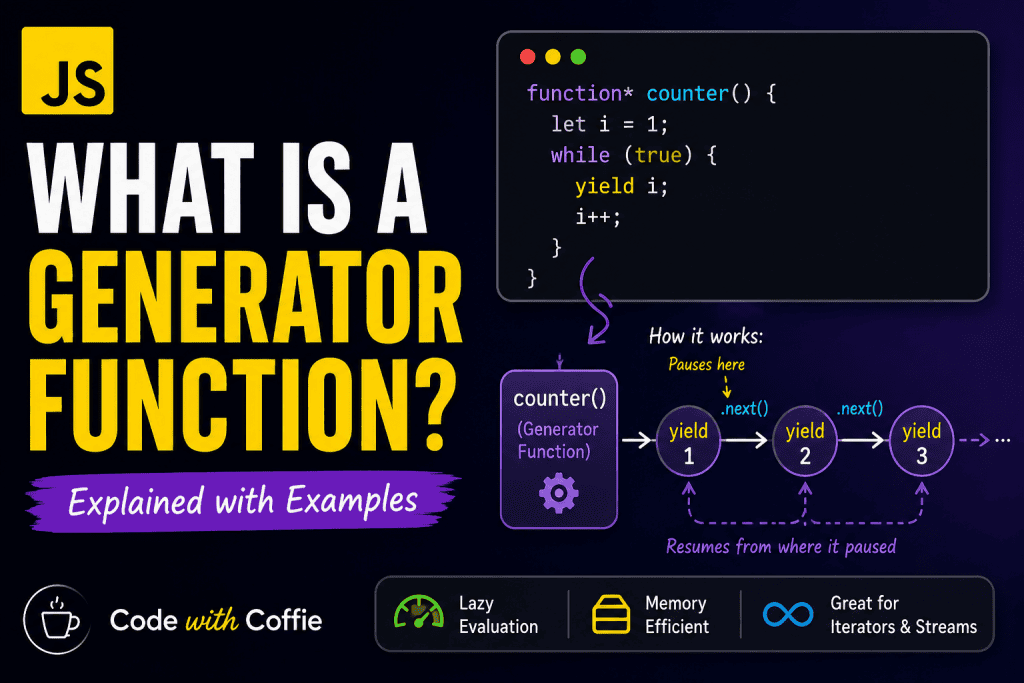
A generator function in JavaScript (or Python, since both use similar concepts) is a special type of function that can pause its execution and later resume. Instead of returning a single value like a normal function, it yields multiple values over time, one at a time, which makes it very memory-efficient for handling large datasets or sequences.
Here’s a breakdown:
Key Features
- Defined using
function*(asterisk) in JavaScript. - Uses
yieldto produce a value and pause execution. - Returns an iterator (an object with a
next()method). - Can maintain state between executions.
Example in JavaScript
function* numbers() {
  yield 1;
  yield 2;
  yield 3;
}

const gen = numbers();

console.log(gen.next()); // { value: 1, done: false }
console.log(gen.next()); // { value: 2, done: false }
console.log(gen.next()); // { value: 3, done: false }
console.log(gen.next()); // { value: undefined, done: true }
value→ the yielded valuedone→ indicates if the generator is finished
Use Cases
- Iterating over large datasets without loading everything into memory.
- Implementing lazy evaluation (compute values only when needed).
- Creating infinite sequences (like Fibonacci numbers).
No comments yet! You be the first to comment.