
Explain MySQL storage engines.
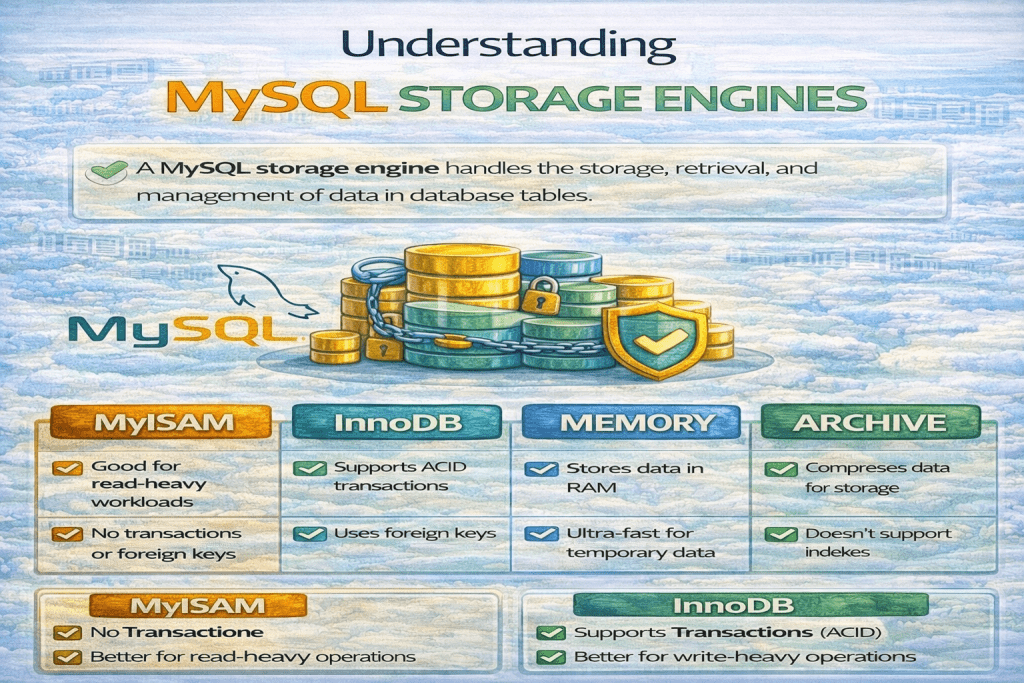
MySQL storage engines are the components that handle how data is stored, retrieved, and managed in a database. Each storage engine has its own way of managing tables, indexes, transactions, and locking mechanisms. You can think of a storage engine as the “backend” for your MySQL tables. MySQL supports multiple storage engines, and you can choose the one that best fits your use case.
Here’s a detailed explanation:
1. What is a Storage Engine?
A storage engine is the part of MySQL that actually stores and manages the data in tables. When you create a table, you can specify a storage engine using:
CREATE TABLE my_table (
    id INT PRIMARY KEY,
    name VARCHAR(50)
) ENGINE=InnoDB;
If you don’t specify an engine, MySQL uses the default storage engine (usually InnoDB in modern versions).
2. Common MySQL Storage Engines
a) InnoDB
- Default engine in MySQL 5.5+
- Supports: ACID transactions, foreign keys, row-level locking
- Pros:
- Reliable for transactional workloads
- Crash-safe (data is not lost on crash)
- Good for high-concurrency applications
- Cons:
- Slightly slower for read-heavy, simple queries than MyISAM
b) MyISAM
- Legacy engine, default in older MySQL versions
- Supports: Only table-level locking, no transactions
- Pros:
- Fast for read-heavy applications
- Simple and lightweight
- Cons:
- No transactions or foreign keys
- Table can get corrupted on crash
c) MEMORY (HEAP)
- Stores data in RAM, so extremely fast
- Pros:
- Very fast for temporary tables or caching
- Cons:
- Data is volatile; lost when MySQL restarts
- Limited by RAM size
d) CSV
- Stores data in CSV files
- Pros:
- Easy to import/export to other applications
- Cons:
- No indexes, slow for large datasets
- Only suitable for simple storage
e) ARCHIVE
- Optimized for storing large amounts of data that is rarely read
- Pros:
- Compressed, reduces storage
- Cons:
- No indexes (except auto-increment), read is slow
- Cannot update or delete rows
f) NDB (Clustered)
- Used in MySQL Cluster
- Data is distributed across multiple nodes for high availability
- Pros:
- High redundancy and scalability
- Real-time access
- Cons:
- Complex setup
- Limited functionality compared to InnoDB
3. Comparison Table
| Engine | Transactions | Foreign Keys | Locking | Best Use Case |
|---|---|---|---|---|
| InnoDB | Yes | Yes | Row-level | General-purpose, transactional apps |
| MyISAM | No | No | Table-level | Read-heavy apps, logging |
| MEMORY | No | No | Table-level | Temporary tables, caching |
| CSV | No | No | Table-level | Data import/export |
| ARCHIVE | No | No | Table-level | Historical/log data storage |
| NDB | Yes | No | Row-level | Distributed, high-availability apps |
4. Key Points
- Choice depends on use case:
- Transactional apps → InnoDB
- Analytics/read-heavy → MyISAM or ARCHIVE
- Temp data → MEMORY
- Mixing engines: Different tables in the same database can use different engines.
- Engine features matter: ACID compliance, locking, crash recovery, indexing, and performance vary by engine.
No comments yet! You be the first to comment.