
Explain the difference between CHAR and VARCHAR.
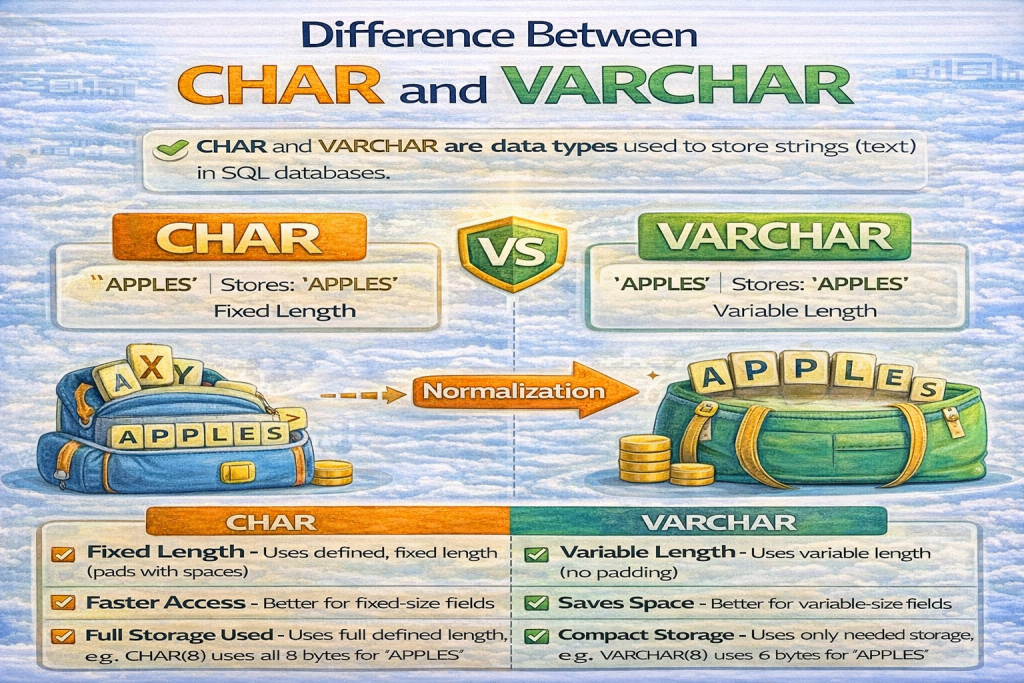
In MySQL, CHAR and VARCHAR are both used to store text/string data, but they behave differently in terms of storage, length, and performance. Here’s a detailed comparison:
1. Storage and Length
| Feature | CHAR | VARCHAR |
|---|---|---|
| Length | Fixed-length | Variable-length |
| Storage | Always uses the full declared length. If you define CHAR(10) and store 'Hi', it still uses 10 bytes (padded with spaces). | Only uses as much storage as needed for the string plus 1 or 2 bytes for length. 'Hi' in VARCHAR(10) uses 2 bytes + 2 bytes (for length) = 4 bytes. |
| Maximum Length | 0–255 | 0–65535 (depending on row size and character set) |
2. Padding
- CHAR: Pads the remaining space with spaces to meet the fixed length.
CHAR(5): 'Hi' → stored as 'Hi '
- VARCHAR: Stores the exact string without extra spaces.
3. Performance
- CHAR: Faster for fixed-length strings because MySQL knows the exact size of each row.
- VARCHAR: Slightly slower for updates/reads in some cases because the length varies, and extra bytes are used to store the length.
4. Use Cases
- CHAR: Best for fixed-length data like:
- Country codes (
'USA','IND') - Status codes (
'Y','N')
- Country codes (
- VARCHAR: Best for variable-length data like:
- Names
- Email addresses
- Descriptions
5. Trailing Spaces Behavior
- CHAR: Trailing spaces are trimmed when retrieving data.
- VARCHAR: Trailing spaces are kept as entered.
✅ Summary:
- CHAR → fixed-length, faster for short, consistent-sized strings.
- VARCHAR → variable-length, saves space for strings of varying sizes.
No comments yet! You be the first to comment.