
Explain type juggling in PHP.
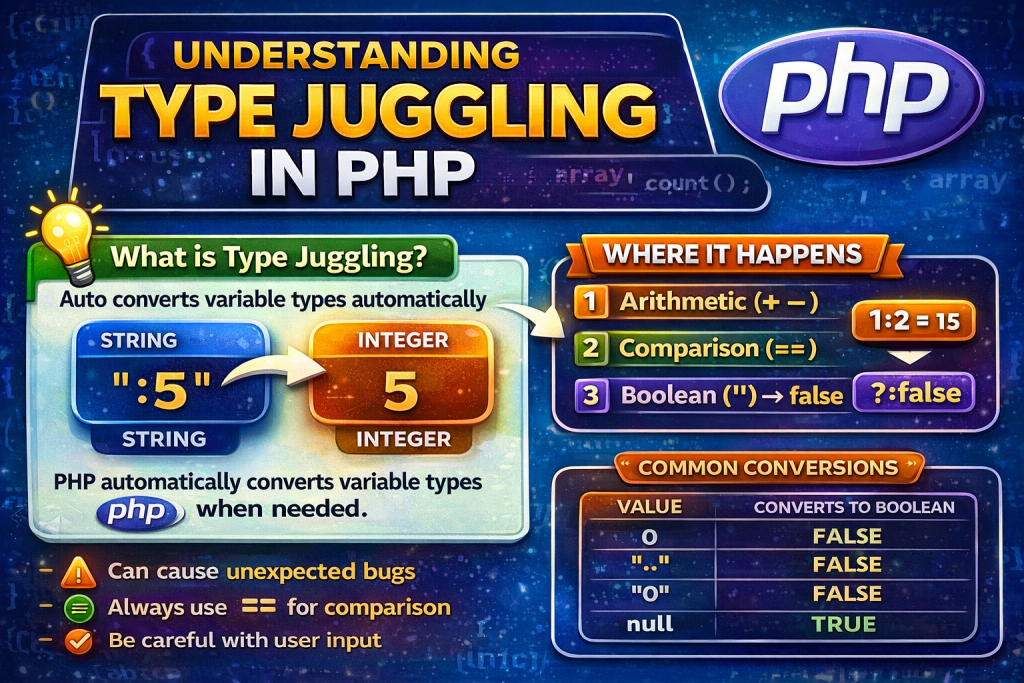
Type juggling in PHP means automatic type conversion that happens when you use variables in different contexts.
Since PHP is a loosely typed (dynamically typed) language, you don’t need to declare the type of a variable; PHP decides the type at runtime based on the value and context.
🔹 Example of Type Juggling
<?php
$a = "10";   // string
$b = 5;      // integer

echo $a + $b;  // Output: 15 (string "10" is converted to int 10)
Here, PHP automatically juggles the string "10" into an integer 10 because the + operator expects numbers.
🔹 Common Type Juggling Scenarios
- String to Number Conversion
$x = "100";  // string
$y = $x + 20;
echo $y;     // 120 (string converted to integer)
- Boolean Conversion
var_dump((bool)"0");   // false
var_dump((bool)"");    // false
var_dump((bool)"abc"); // true
- Loose Comparison (
==)
var_dump(0 == "0");      // true
var_dump(0 == "abc");    // true (string converted to 0)
var_dump("123" == 123);  // true
- Strict Comparison (
===)
var_dump("123" === 123); // false (types differ)
🔹 Problems with Type Juggling
Type juggling often leads to unexpected results, especially with ==:
var_dump("0" == 0);     // true
var_dump("0" == "");    // true
var_dump(0 == false);   // true
var_dump("0" == false); // true (confusing!)
🔹 Best Practices
- Use strict comparison (
===and!==) to avoid unwanted type juggling. - Explicitly cast types when needed:
(int)"123";   // 123
(bool)1;      // true
(string)45;   // "45"
✅ In short:
Type juggling in PHP is the automatic conversion of one data type to another depending on the context (arithmetic, comparison, boolean, etc.). It’s powerful but can also be dangerous if you rely on loose comparisons.
No comments yet! You be the first to comment.