
Difference between master-slave and master-master replication?
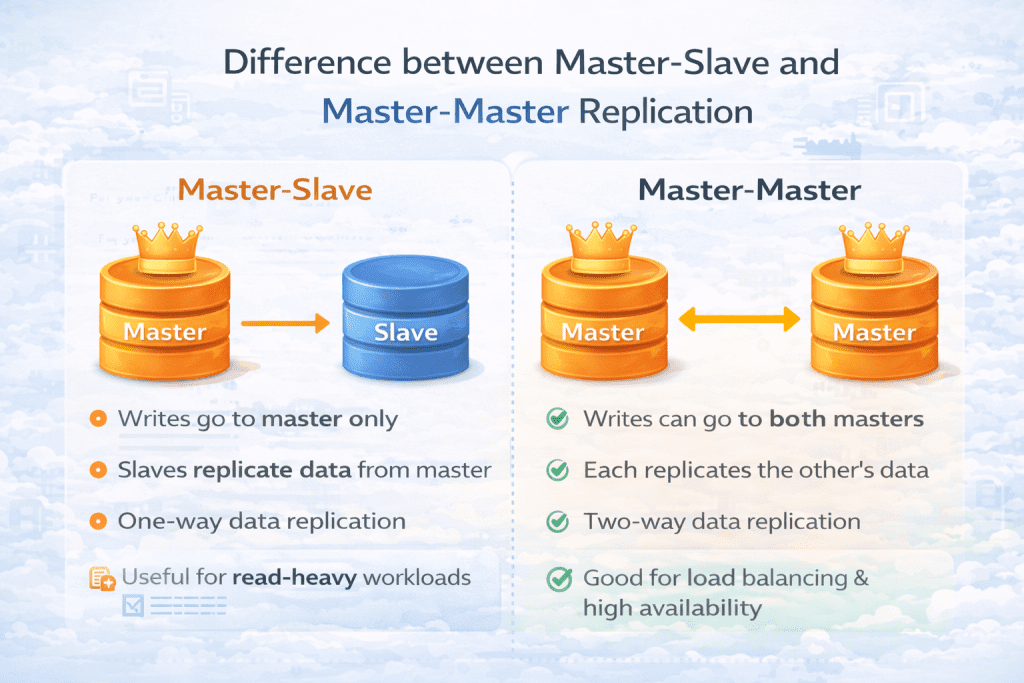
Here’s a clear comparison of Master-Slave vs Master-Master replication in MySQL:
🔹 Master-Slave Replication
- Definition: One server (master) handles all write operations, and the other server(s) (slaves) replicate data from the master.
- Writes: Only allowed on the master.
- Reads: Usually performed on slaves to reduce load on the master.
- Use Case: Load balancing (read scaling), backups, reporting.
- Failover: If the master fails, a slave needs to be promoted manually (or via automation) to act as master.
- Data Flow: One-directional (Master ➝ Slave).
- Conflict Handling: No conflict (since only master handles writes).
🔹 Master-Master Replication
- Definition: Two (or more) servers act as masters, and replicate data to each other.
- Writes: Can be performed on both masters.
- Reads: Can be done on both masters (or additional slaves).
- Use Case: High availability, failover without downtime, distributed writes.
- Failover: Easier, because if one master goes down, the other can take over immediately.
- Data Flow: Bi-directional (Master ⇆ Master).
- Conflict Handling: Possible conflicts if the same row is updated on both masters at the same time (requires conflict resolution strategies).
🔑 Key Differences Table
| Feature | Master-Slave Replication | Master-Master Replication |
|---|---|---|
| Writes | Only on Master | On both Masters |
| Reads | Mainly on Slaves | On both Masters (and slaves) |
| Replication Direction | One-way (→) | Two-way (⇆) |
| Failover | Manual / semi-automatic | Automatic / seamless |
| Conflict Risk | None | High (requires resolution) |
| Use Case | Read scaling, backups | High availability, HA failover |
👉 In short:
- Master-Slave = simpler, safe, mainly for read-heavy systems.
- Master-Master = more complex, better for high availability and distributed writes, but needs careful conflict handling.
No comments yet! You be the first to comment.