
What is a cursor in MySQL?
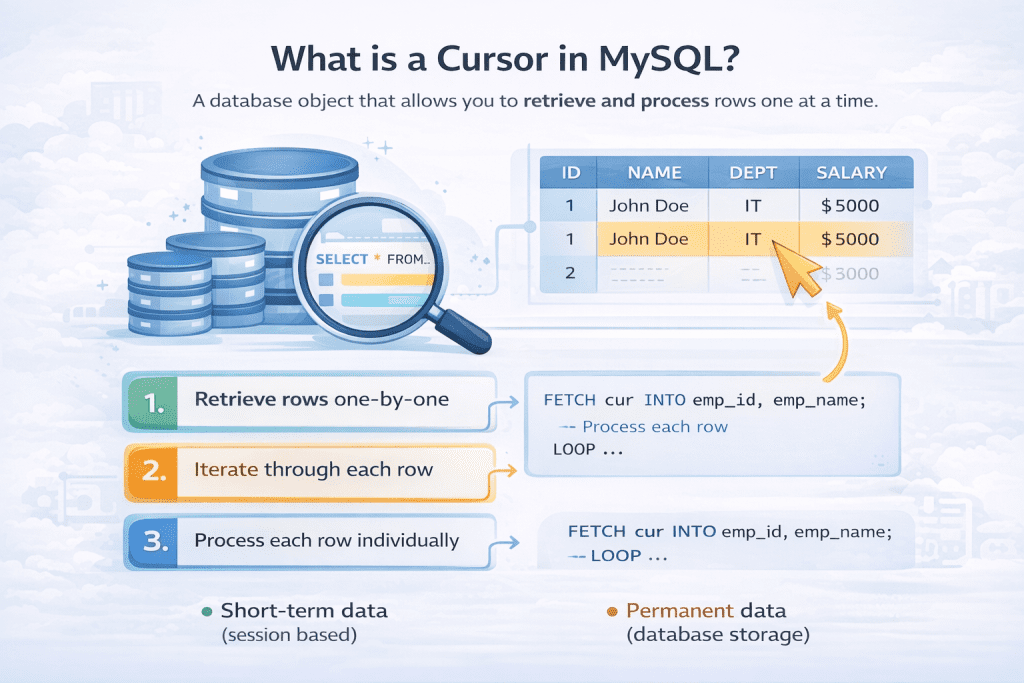
In MySQL, a cursor is a database object that allows you to retrieve and manipulate rows from a result set one at a time. Unlike a normal SELECT query that returns all rows at once, a cursor lets you process each row individually, which is useful in procedural code like stored procedures, functions, or triggers.
Here’s a detailed breakdown:
Key Points About Cursors
- Purpose:
- Used to handle multiple rows returned by a query in a row-by-row manner.
- Essential when you need to perform operations on each row individually, such as updating, logging, or conditional processing.
- Types of Cursors in MySQL:
MySQL supports only explicit cursors in stored programs. There are no implicit cursors exposed to the user like in some other DBMS. - Cursor Operations:
A typical cursor workflow involves these steps:- Declare a cursor for a
SELECTstatement. - Open the cursor to establish the result set.
- Fetch rows one by one from the cursor into variables.
- Process the data as required.
- Close the cursor to free resources.
- Declare a cursor for a
Syntax Example
DELIMITER //

CREATE PROCEDURE process_employees()
BEGIN
    -- Declare variables to hold fetched data
    DECLARE emp_name VARCHAR(50);
    DECLARE emp_salary DECIMAL(10,2);

    -- Declare a cursor for selecting employees
    DECLARE emp_cursor CURSOR FOR
        SELECT name, salary FROM employees;

    -- Declare a handler for when no more rows are left
    DECLARE CONTINUE HANDLER FOR NOT FOUND SET done = TRUE;

    -- Open the cursor
    OPEN emp_cursor;

    -- Loop through each row
    read_loop: LOOP
        FETCH emp_cursor INTO emp_name, emp_salary;
        IF done THEN
            LEAVE read_loop;
        END IF;

        -- Example operation: print employee info
        SELECT CONCAT('Employee: ', emp_name, ', Salary: ', emp_salary);
    END LOOP;

    -- Close the cursor
    CLOSE emp_cursor;
END //

DELIMITER ;
Advantages
- Allows row-by-row processing in stored procedures.
- Can perform complex logic on each row that can’t be done easily with a single SQL query.
- Useful for conditional updates or aggregations that are procedural in nature.
Limitations
- Slower than set-based operations (
UPDATE/INSERTwithWHERE) because it processes one row at a time. - Must be used inside stored procedures, functions, or triggers.
✅ Summary:
A cursor in MySQL is a tool for iterating over query results row by row, primarily in procedural SQL blocks. It’s powerful for detailed row-wise processing but should be used carefully due to performance considerations.
No comments yet! You be the first to comment.