
Understanding ACID Properties in Databases
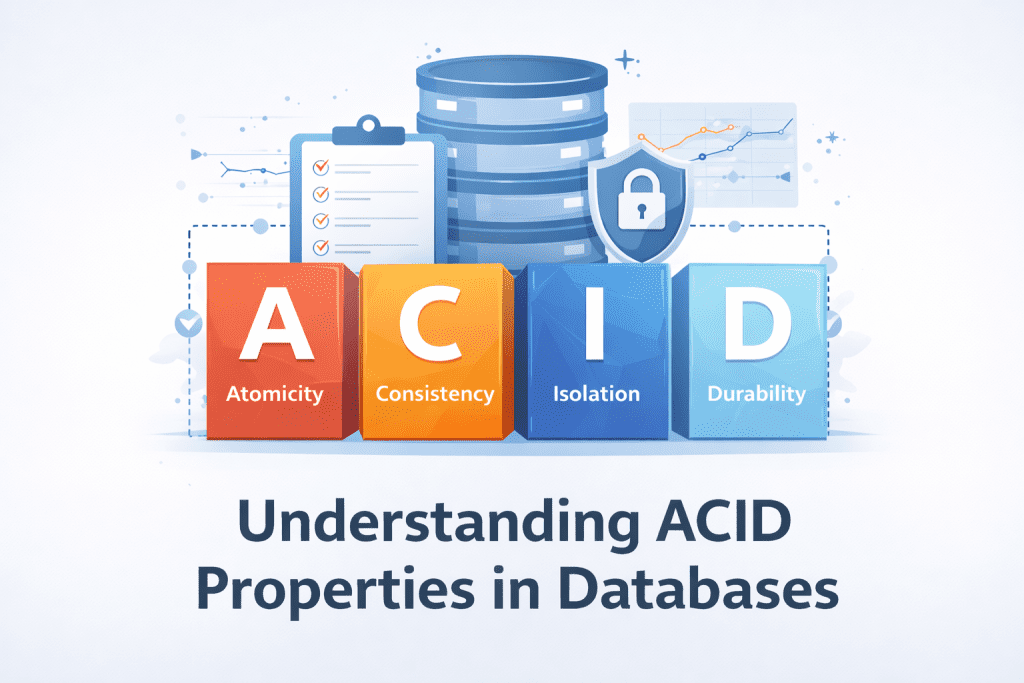
When it comes to databases, especially relational databases like MySQL, PostgreSQL, or Oracle, data integrity and reliability are paramount. One of the foundational concepts that ensure this reliability is ACID properties. These properties define how a database transaction should behave to maintain consistency and correctness.
In this blog, we will explore what ACID properties are, their importance, and examples to make them easier to understand.
What is a Transaction?
Before diving into ACID, it’s important to understand what a transaction is:
A transaction is a sequence of one or more database operations (like insert, update, delete) that are executed as a single unit of work. A transaction should either complete fully or not happen at all.
Example:
BEGIN TRANSACTION;

UPDATE accounts SET balance = balance - 500 WHERE account_id = 1;
UPDATE accounts SET balance = balance + 500 WHERE account_id = 2;

COMMIT;
In this example, money is being transferred from one account to another. Both updates must succeed; if one fails, the entire transaction should roll back to avoid inconsistencies.
ACID Properties
ACID stands for Atomicity, Consistency, Isolation, and Durability. Let’s break each property down.
1. Atomicity (All or Nothing)
Definition:
Atomicity ensures that a transaction is treated as a single unit, which either completes entirely or does not happen at all. If any part of the transaction fails, the entire transaction is rolled back.
Example:
Continuing the previous example: if the first account debit succeeds but the credit to the second account fails, the database will rollback the debit so that no money is lost.
Key Point:
Atomicity prevents partial updates that could leave data in an inconsistent state.
2. Consistency (Valid Data State)
Definition:
Consistency ensures that a transaction brings the database from one valid state to another, maintaining all defined rules, constraints, and triggers.
Example:
- If an account balance cannot be negative, the transaction should fail if it tries to make it negative.
- Foreign key constraints, unique constraints, and triggers help enforce consistency.
Key Point:
Consistency ensures the integrity of data rules is never violated.
3. Isolation (Transactions Do Not Interfere)
Definition:
Isolation ensures that concurrent transactions do not affect each other. The intermediate state of a transaction is invisible to other transactions until it is committed.
Isolation Levels:
Databases provide different isolation levels like:
- Read Uncommitted – may read uncommitted data (dirty read)
- Read Committed – only committed data is read
- Repeatable Read – ensures the same rows are read consistently
- Serializable – highest isolation, transactions behave as if executed sequentially
Example:
Two users transferring money simultaneously:
- User A transfers $100 from Account 1 to Account 2.
- User B transfers $50 from Account 1 to Account 3.
Isolation ensures that these transactions do not interfere and the balance calculations remain correct.
Key Point:
Isolation prevents data anomalies during concurrent access.
4. Durability (Permanent Changes)
Definition:
Durability ensures that once a transaction is committed, it will persist even in the event of a system crash or power failure.
Example:
After a successful money transfer, even if the database server crashes immediately, the changes are stored permanently in the database.
Key Point:
Durability guarantees data persistence.
Why ACID Properties Are Important
- Data Integrity: Prevents corruption and maintains accurate data.
- Reliability: Users and applications can trust the database.
- Concurrency Control: Multiple users can access data without conflicts.
- Error Handling: Partial or failed transactions do not harm the system.
ACID in Real Life
Imagine an online shopping system:
- Atomicity: Payment and order creation happen together.
- Consistency: Stock levels should not go negative.
- Isolation: Two users cannot buy the same last item at the same time incorrectly.
- Durability: Orders and payments are not lost even if the system crashes.
ACID vs BASE
ACID is often compared to BASE in NoSQL databases:
- ACID: Strict consistency, reliability, relational databases.
- BASE: Basically Available, Soft state, Eventually consistent, more flexible for distributed systems.
Conclusion
ACID properties are the backbone of reliable and consistent relational databases. They ensure that every transaction is processed safely, consistently, and permanently, even in the face of errors or concurrent access.
Understanding ACID is crucial for developers, database administrators, and anyone working with critical data. Implementing and respecting these properties ensures that your database remains robust, trustworthy, and consistent at all times.