
Events and Listeners in Laravel: A Complete Guide
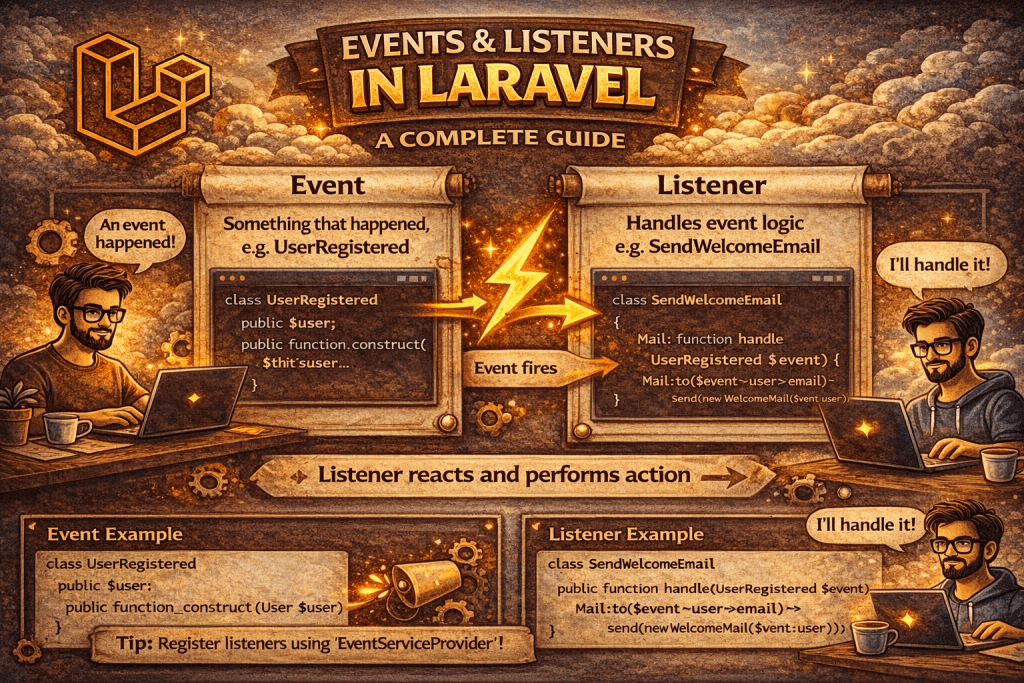
Laravel is a powerful PHP framework that provides a clean and elegant way to build modern web applications. Among its many features, the Events and Listeners system stands out as a robust way to implement event-driven programming. In this blog, we’ll dive deep into what events and listeners are, why they are useful, and how to implement them in Laravel.
What are Events in Laravel?
In Laravel, events are actions or occurrences that happen in your application. They allow your application to react to certain actions without tightly coupling your code.
Think of an event as a signal that something has happened. For example:
- A user has registered.
- An order has been placed.
- A comment has been posted.
Events are declarative, meaning you define them and then “fire” them when something happens.
Benefits of Using Events
- Decoupling – Events allow you to separate different parts of your application. For example, sending an email after user registration doesn’t need to be in the controller.
- Reusability – Listeners can be reused for multiple events.
- Clean Code – Reduces the complexity in controllers and models.
- Scalability – You can add more listeners later without modifying the core logic.
What are Listeners in Laravel?
Listeners are classes that handle the logic when an event is triggered. You can think of them as reaction handlers.
For example:
- When a
UserRegisteredevent is fired, aSendWelcomeEmaillistener will handle sending an email. - When an
OrderPlacedevent is fired, aNotifyAdminlistener can notify the admin via SMS or email.
Listeners keep your application organized and modular, and allow for multiple reactions to a single event.
How Events and Listeners Work Together
- Create an Event → This represents something that happened.
- Create a Listener → This will handle what should happen when the event occurs.
- Register the Event and Listener in
EventServiceProvider. - Fire the Event → Laravel will automatically call the corresponding listeners.
Step-by-Step Implementation
Let’s implement a simple example: sending a welcome email when a new user registers.
1. Create an Event
You can generate an event using Artisan:
php artisan make:event UserRegistered
This will create a file in app/Events/UserRegistered.php:
<?php

namespace App\Events;

use App\Models\User;
use Illuminate\Foundation\Events\Dispatchable;
use Illuminate\Queue\SerializesModels;

class UserRegistered
{
    use Dispatchable, SerializesModels;

    public $user;

    public function __construct(User $user)
    {
        $this->user = $user;
    }
}
Here, we pass the User object to the event so listeners can use it.
2. Create a Listener
Next, generate a listener:
php artisan make:listener SendWelcomeEmail --event=UserRegistered
This creates app/Listeners/SendWelcomeEmail.php:
<?php

namespace App\Listeners;

use App\Events\UserRegistered;
use Illuminate\Contracts\Queue\ShouldQueue;
use Illuminate\Support\Facades\Mail;
use App\Mail\WelcomeMail;

class SendWelcomeEmail implements ShouldQueue
{
    public function handle(UserRegistered $event)
    {
        Mail::to($event->user->email)->send(new WelcomeMail($event->user));
    }
}
ShouldQueueensures that sending email is queued and doesn’t slow down the response.- The
handle()method contains the logic for the listener.
3. Register Event and Listener
Open app/Providers/EventServiceProvider.php and register the event-listener pair:
protected $listen = [
    \App\Events\UserRegistered::class => [
        \App\Listeners\SendWelcomeEmail::class,
    ],
];
4. Fire the Event
Finally, when a user registers, fire the event in your controller:
use App\Events\UserRegistered;
use App\Models\User;

public function register(Request $request)
{
    $user = User::create($request->all());

    // Fire the event
    event(new UserRegistered($user));

    return response()->json(['message' => 'User registered successfully!']);
}
Laravel will automatically call the SendWelcomeEmail listener.
Advanced Concepts
1. Queued Events
You can make listeners queued by implementing ShouldQueue:
use Illuminate\Contracts\Queue\ShouldQueue;

class SendWelcomeEmail implements ShouldQueue
This allows your app to handle heavy tasks asynchronously.
2. Multiple Listeners for a Single Event
You can attach multiple listeners to one event. For example:
protected $listen = [
    UserRegistered::class => [
        SendWelcomeEmail::class,
        NotifyAdmin::class,
    ],
];
Both listeners will be executed when the event is fired.
3. Event Subscribers
Subscribers are classes that can subscribe to multiple events. They are useful when a class handles multiple related events.
Conclusion
Laravel’s Events and Listeners system is a powerful tool for decoupling code, improving maintainability, and handling asynchronous tasks. By separating the core logic from side effects like sending emails, logging, or notifications, your application remains clean and scalable.
Whether you’re building small apps or large enterprise-level projects, mastering events and listeners is essential for writing professional Laravel applications.
✅ Key Takeaways:
- Events signal that something has happened.
- Listeners handle what should happen in response.
- They decouple logic and improve maintainability.
- Laravel provides queued listeners for asynchronous tasks.
- Multiple listeners can respond to a single event.
What are Events in Laravel?
Events in Laravel provide a simple observer implementation that allows you to subscribe and listen to various events that occur in your application. For example, sending a welcome email when a user registers.
What are Listeners in Laravel?
Listeners handle the event’s logic. They receive the event instance and perform the associated task, such as sending notifications or logging information.
Why do we use Events and Listeners?
To decouple code.
To handle asynchronous tasks.
To improve maintainability and scalability.
To avoid putting all logic into controllers or models.
How do you create an Event and Listener in Laravel?
Create an event:
php artisan make:event UserRegistered
Create a listener:
php artisan make:listener SendWelcomeEmail --event=UserRegistered
How do you register Events and Listeners in Laravel?
They are registered in app/Providers/EventServiceProvider.php inside the $listen array. Example:
protected $listen = [ UserRegistered::class => [ SendWelcomeEmail::class, ], ];
How do you dispatch an Event in Laravel?
event(new UserRegistered($user));
Or using the helper:
UserRegistered::dispatch($user);
What is the difference between Events and Listeners?
Event: Something that happens (e.g., “UserRegistered”).
Listener: Responds to the event and performs an action (e.g., “SendWelcomeEmail”).
Can one event have multiple listeners?
Yes, one event can have multiple listeners. Example:
protected $listen = [
UserRegistered::class => [
SendWelcomeEmail::class,
LogUserRegistration::class,
NotifyAdmin::class,
],
];
What are queued listeners in Laravel?
Listeners can be queued so that heavy tasks (e.g., sending emails) run in the background using Laravel’s queue system. You just need to implement ShouldQueue interface in the listener class.
class SendWelcomeEmail implements ShouldQueue
{
public function handle(UserRegistered $event) { … }
}
What’s the difference between event() helper and dispatch() method?
Both are used to trigger events.dispatch() is just a cleaner alias introduced for readability.
Example:
event(new OrderPlaced($order)); OrderPlaced::dispatch($order); // same
Can you stop event propagation in Laravel?
Yes, by using return false; in the listener’s handle() method. This stops other listeners of the same event from being executed.
What is the ShouldDiscoverEvents interface in EventServiceProvider?
It allows automatic event discovery instead of manually registering them in $listen. If enabled, Laravel scans your Listeners folder to find listeners dynamically.
Difference between Events/Listeners vs. Observers in Laravel?
Events/Listeners: More flexible, used for decoupled tasks (e.g., user registration event triggers multiple actions).
Observers: Tied to model lifecycle events (e.g., creating, updating, deleted).
How do you broadcast events in Laravel?
By implementing the ShouldBroadcast interface in the event class. Example:
class OrderPlaced implements ShouldBroadcast
{
public $order;public function __construct($order) { $this->order = $order; } public function broadcastOn() { return ['orders']; }
}
What are some real-world examples of using Events and Listeners?
Send welcome email when a user registers.
Log user login activity.
Notify admin when an order is placed.
Invalidate cache when a product is updated.
Can an Event exist without a Listener?
Yes. Events can exist without listeners. Sometimes you only want to broadcast events (for frontend apps like Vue/React) without handling them on the backend.
Can a Listener listen to multiple events?
Yes, but indirectly. Usually, one listener is tied to one event, but you can manually attach the same listener to multiple events in EventServiceProvider.
How can you pass data to a Listener from an Event?
By defining public properties in the Event class and then accessing them in the
Listener.
class UserRegistered { public $user; public function __construct(User $user) { $this->user = $user; } }
Listener:
public function handle(UserRegistered $event) { $event->user->email; }
What’s the difference between synchronous and queued listeners?
Synchronous: Runs immediately when the event is fired.
Queued: Runs later using Laravel’s queue system (ideal for heavy tasks).
How do you test Events & Listeners in Laravel?
Laravel provides two helpers:Event::fake() → Prevents actual events from firing.Event::assertDispatched(EventClass::class) → Verifies if event was fired.
Example:
Event::fake(); $user = User::factory()->create(); Event::assertDispatched(UserRegistered::class);
Difference between EventServiceProvider $listen and $subscribe?
$listen → Maps events to listeners directly.$subscribe → Registers a subscriber class that may listen to multiple events.