
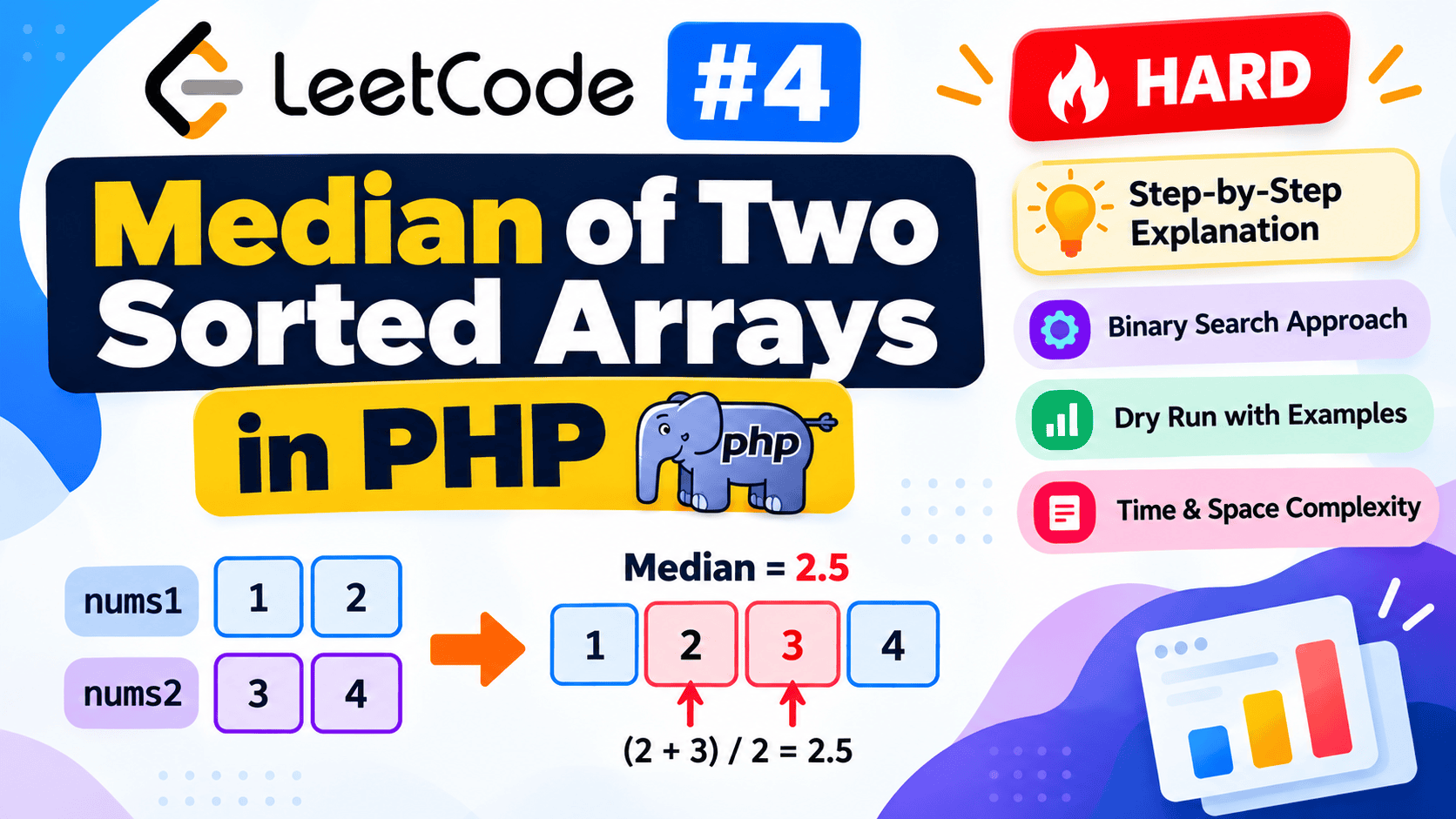
LeetCode 4: Median of Two Sorted Arrays in PHP
LeetCode Problem 4, Median of Two Sorted Arrays, is a popular coding interview question that tests your understanding of binary search, sorted arrays, and partitioning.
In this tutorial, we will solve this problem using PHP with a simple, step-by-step explanation. We’ll first understand what the median is, then look at an easy approach, understand why it is not optimal, and finally implement the efficient binary search solution.
Even though LeetCode marks this problem as Hard, the main idea becomes much easier once you understand how to divide two sorted arrays into left and right halves.
1. Problem Statement
You are given two sorted arrays, nums1 and nums2, of sizes m and n, respectively. Your task is to find the median of the two sorted arrays.
The overall time complexity of your solution must be O(log(m+n)).
Example 1
Input:
nums1 = [1, 3]
nums2 = [2]
Output: 2.00000
Explanation: If we combine the arrays, we get [1, 2, 3]. The middle element is 2, so the median is 2.
Example 2
Input:
nums1 = [1, 2]
nums2 = [3, 4]
Output: 2.50000
Explanation: The combined sorted array is [1, 2, 3, 4]. There are four elements, so the median is the average of the two middle values: (2 + 3) / 2 = 2.5.
Constraints
nums1.length == mnums2.length == n0 <= m <= 10000 <= n <= 10001 <= m + n <= 2000-10⁶ <= nums1[i], nums2[i] <= 10⁶
2. What Is a Median?
The median is the middle value of a sorted collection of numbers.
There are two cases to remember:
Case 1: Odd Number of Elements
When the total number of elements is odd, the median is the single middle element.
Example: [1, 2, 3, 4, 5]
The middle element is highlighted in blue.
Median = 3
Case 2: Even Number of Elements
When the total number of elements is even, there are two middle elements. The median is their average.
Example: [1, 2, 3, 4]
The two middle elements are highlighted.
Median = (2 + 3) / 2 = 2.5
Our task is to find this median without necessarily combining the two arrays.
3. Understanding the Problem
Let’s take two sorted arrays:
nums1
nums2
Both arrays are already sorted, but their elements are spread across two separate arrays.
If we combine them in sorted order, we get:
The middle element is 2, so the answer is 2.
The challenge is to find the middle value efficiently, without doing unnecessary work. The problem specifically requires logarithmic time, which leads us to binary search.
4. Brute Force Approach (Easy to Understand)
The easiest way to solve this problem is to merge both sorted arrays into one sorted array and then find the median.
PHP Code – Brute Force
class Solution {
    function findMedianSortedArrays($nums1, $nums2) {
        $merged = array_merge($nums1, $nums2);
        sort($merged);

        $total = count($merged);
        $mid = intdiv($total, 2);

        if ($total % 2 == 1) {
            return $merged[$mid];
        }

        return ($merged[$mid - 1] + $merged[$mid]) / 2;
    }
}
How This Approach Works
- Combine both arrays using
array_merge(). - Sort the merged array using
sort(). - Calculate the middle index.
- If the total length is odd, return the middle element.
- If the total length is even, calculate the average of the two middle elements.
5. Optimal Approach: Binary Search
To achieve the required O(log(m+n)) time complexity, we can use binary search to find a correct partition across the two arrays.
Instead of merging the arrays, we divide their elements into two halves:
- The left half contains the smaller elements.
- The right half contains the larger elements.
- Every element on the left must be less than or equal to every element on the right.
- The left half should contain the same number of elements as the right half, or exactly one extra element if the total count is odd.
Once we find such a partition, the median can be calculated using only the values at the partition boundaries.
6. Visualizing the Partition
Let’s use the first example:
nums1 = [1, 3]
nums2 = [2]
There are three total elements. We want two elements on the left and one on the right.
Correct partition
nums1:
nums2:
Left half: [1, 2]
Right half: [3]
Every value on the left is less than or equal to every value on the right.
Median = maximum of left half = 2
We don’t need to actually create these halves in memory. We only need to calculate where each array should be divided.
7. How to Find the Correct Partition
We use two partition positions:
iis the number of elements taken fromnums1into the left half.jis the number of elements taken fromnums2into the left half.
We calculate the total number of elements that should be in the left half:
$half = intdiv($m + $n + 1, 2);
$j = $half - $i;
We always search for the partition in the smaller array. This ensures that our binary search operates on the fewest possible elements.
Partition Boundary Values
For a chosen partition, we define four boundary values:
| Variable | Meaning |
|---|---|
maxLeft1 | Largest value in the left part of nums1 |
minRight1 | Smallest value in the right part of nums1 |
maxLeft2 | Largest value in the left part of nums2 |
minRight2 | Smallest value in the right part of nums2 |
The partition is correct when both conditions are satisfied:
maxLeft1 <= minRight2
maxLeft2 <= minRight1
These conditions ensure that no element in the left half is greater than an element in the right half.
8. Step-by-Step Binary Search Example
Consider:
nums1 = [1, 3]
nums2 = [2]
First, we make sure that nums1 is the smaller array. Its length is 2 and nums2’s length is 1, so we swap them for the search.
Now:
nums1 = [2], nums2 = [1, 3]
Step 1: Calculate the Left Half Size
Total length = 1 + 2 = 3.
Since the total is odd:
$half = intdiv(1 + 2 + 1, 2);
// $half = 2
We need 2 elements in the left half.
Step 2: Initialize Binary Search
Our smaller array is [2], so the possible partition positions range from 0 to 1.
$low = 0;
$high = 1;

$i = intdiv($low + $high, 2); // 0
$j = $half - $i;              // 2
Step 3: Check the First Partition
With i = 0 and j = 2:
nums1 = [2]
nums2 = [1, 3]
Here, the left side of nums2 contains [1,3], while the right side of nums1 contains [2].
maxLeft2 = 3 and minRight1 = 2.
Since 3 > 2, the partition is incorrect. We have taken too few elements from nums1, so we move the binary search to the right.
Step 4: Update the Search Range
$low = $i + 1;Now low = 1 and high = 1. The next partition position is i = 1, and:
$i = 1;
$j = $half - $i; // 1
Step 5: Check the Correct Partition
nums1 = [2]
nums2 = [1, 3]
Left half: [2, 1]
Right half: [3]
Boundary values:
- maxLeft1 = 2
- minRight1 = infinity (no elements remain on the right of nums1)
- maxLeft2 = 1
- minRight2 = 3
Check the conditions:
- 2 <= 3 → True
- 1 <= infinity → True
Both conditions are satisfied, so we have found the correct partition.
Median = max(2, 1) = 2
We found the median using binary search without merging the two arrays.
9. Complete PHP Solution
Here is the optimized solution for the LeetCode PHP editor. It handles odd and even total lengths, empty individual arrays, and negative numbers.
class Solution {
    function findMedianSortedArrays($nums1, $nums2) {
        // Always binary search the smaller array
        if (count($nums1) > count($nums2)) {
            [$nums1, $nums2] = [$nums2, $nums1];
        }

        $m = count($nums1);
        $n = count($nums2);

        $low = 0;
        $high = $m;
        $half = intdiv($m + $n + 1, 2);

        while ($low <= $high) {
            $i = intdiv($low + $high, 2);
            $j = $half - $i;

            $maxLeft1 = ($i == 0)
                ? PHP_INT_MIN : $nums1[$i - 1];

            $minRight1 = ($i == $m)
                ? PHP_INT_MAX : $nums1[$i];

            $maxLeft2 = ($j == 0)
                ? PHP_INT_MIN : $nums2[$j - 1];

            $minRight2 = ($j == $n)
                ? PHP_INT_MAX : $nums2[$j];

            // Check if the partition is correct
            if (
                $maxLeft1 <= $minRight2 &&
                $maxLeft2 <= $minRight1
            ) {
                // Odd total: return the largest left value
                if (($m + $n) % 2 == 1) {
                    return max($maxLeft1, $maxLeft2);
                }

                // Even total: average the middle two values
                $leftMax = max($maxLeft1, $maxLeft2);
                $rightMin = min($minRight1, $minRight2);

                return ($leftMax + $rightMin) / 2;
            }

            // Move left or right in the smaller array
            if ($maxLeft1 > $minRight2) {
                $high = $i - 1;
            } else {
                $low = $i + 1;
            }
        }

        return 0;
    }
}PHP_INT_MIN and PHP_INT_MAX act as boundary sentinels when one side of a partition has no elements. The given LeetCode constraints ensure the actual input values are safely between these limits. The final return statement is a fallback; valid sorted inputs always have a correct partition.10. Understanding the Code Line by Line
Step 1: Ensure the First Array Is Smaller
if (count($nums1) > count($nums2)) {
    [$nums1, $nums2] = [$nums2, $nums1];
}
We always perform binary search on the smaller array. This keeps the search range small and ensures the partition in the other array remains within its valid boundaries.
Step 2: Calculate the Half Length
$half = intdiv($m + $n + 1, 2);This calculates how many elements should be placed in the left half. Adding 1 before integer division ensures the left half gets the extra element when the total length is odd.
Step 3: Perform Binary Search
$low = 0;
$high = $m;

while ($low <= $high) {
    $i = intdiv($low + $high, 2);
    $j = $half - $i;
}
The variables low and high define the possible partition positions in the smaller array. Each iteration selects a middle position and calculates the corresponding partition in the other array.
Step 4: Find the Four Boundary Values
$maxLeft1 = ($i == 0)
    ? PHP_INT_MIN : $nums1[$i - 1];

$minRight1 = ($i == $m)
    ? PHP_INT_MAX : $nums1[$i];

$maxLeft2 = ($j == 0)
    ? PHP_INT_MIN : $nums2[$j - 1];

$minRight2 = ($j == $n)
    ? PHP_INT_MAX : $nums2[$j];
These values tell us what the largest value on the left and the smallest value on the right are for each array.
If a partition is at the beginning of an array, the left side is empty, so we use PHP_INT_MIN. If the partition is at the end, the right side is empty, so we use PHP_INT_MAX.
Step 5: Check the Partition
if (
    $maxLeft1 <= $minRight2 &&
    $maxLeft2 <= $minRight1
) {
    // Correct partition
}
Both comparisons must be true for a valid partition. Because each input array is already sorted, checking these two boundary comparisons is enough to ensure the entire left half is less than or equal to the entire right half.
Step 6: Calculate the Median
if (($m + $n) % 2 == 1) {
    return max($maxLeft1, $maxLeft2);
}

$leftMax = max($maxLeft1, $maxLeft2);
$rightMin = min($minRight1, $minRight2);

return ($leftMax + $rightMin) / 2;
For an odd number of elements, the left half contains one extra value, so its maximum is the median. For an even number of elements, we average the maximum value on the left with the minimum value on the right.
Step 7: Adjust the Binary Search Range
if ($maxLeft1 > $minRight2) {
    $high = $i - 1;
} else {
    $low = $i + 1;
}
If the left partition of nums1 has a value that is too large compared with the right partition of nums2, we need fewer elements from nums1 in the left half, so we move left. Otherwise, we need more elements from nums1, so we move right.
11. Dry Run: Example 2
Let’s test the even-length example:
nums1 = [1, 2]
nums2 = [3, 4]
Both arrays are sorted, and the total length is 4. The left half should contain 2 elements.
| Iteration | i | j | maxLeft1 | minRight1 | maxLeft2 | minRight2 | Result |
|---|---|---|---|---|---|---|---|
| 1 | 1 | 1 | 1 | 2 | 3 | 4 | Move right |
| 2 | 2 | 0 | 2 | ∞ | -∞ | 3 | Correct |
Iteration 1
The initial partition is:
nums1: [1 | 2]
nums2: [3 | 4]
Here, i = 1 and j = 1. We have:
- maxLeft1 = 1
- minRight1 = 2
- maxLeft2 = 3
- minRight2 = 4
Since maxLeft2 = 3 is greater than minRight1 = 2, the partition is incorrect. We need more elements from nums1 on the left, so we move right.
Iteration 2
nums1: [1, 2 | ]
nums2: [ | 3, 4]
Now i = 2 and j = 0.
- maxLeft1 = 2
- minRight1 = infinity
- maxLeft2 = -infinity
- minRight2 = 3
Both partition conditions are satisfied. The maximum of the left half is 2, and the minimum of the right half is 3.
Median = (2 + 3) / 2 = 2.5
12. Edge Cases
A good solution should work not only for the examples but also for special inputs.
Case 1: One Array Is Empty
nums1 = []
nums2 = [1]
The median is 1. The algorithm handles this by searching the empty smaller array, while the second array provides the middle value.
Case 2: Both Arrays Have Equal Length
nums1 = [1, 3]
nums2 = [2, 4]
The combined sorted order is [1,2,3,4], and the median is (2 + 3) / 2 = 2.5.
Case 3: Negative Numbers
nums1 = [-5, -3]
nums2 = [-2, -1]
The two middle values are -3 and -2. The median is (-3 + -2) / 2 = -2.5. The algorithm works with negative values because it compares the values directly.
Case 4: All Elements in One Array Are Smaller
nums1 = [1, 2]
nums2 = [10, 11]
The correct partition places both elements of nums1 in the left half and both elements of nums2 in the right half. The median is (2 + 10) / 2 = 6.
13. Time and Space Complexity
Time Complexity: O(log(min(m, n)))
We perform binary search only on the smaller array. Each iteration cuts the possible search range roughly in half. Therefore, the time complexity is:
O(log(min(m, n)))
This is within the required O(log(m+n)) time complexity.
Space Complexity: O(1)
The algorithm uses only a fixed number of variables, such as the partition positions, search boundaries, and four boundary values. It does not create a merged array or another data structure.
- Time: O(log(min(m, n)))
- Auxiliary Space: O(1)
- Approach: Binary Search with Partitioning
14. Brute Force vs Optimal Solution
| Feature | Brute Force | Optimal |
|---|---|---|
| Approach | Merge and sort | Binary search partition |
| Time Complexity | O((m+n) log(m+n)) | O(log(min(m,n))) |
| Auxiliary Space | O(m+n) | O(1) |
| Easy to Understand | Yes | Requires practice |
| Meets Required Complexity | No | Yes |
| Best for Interviews | Baseline explanation | Optimal solution |
15. Common Mistakes to Avoid
- Using the wrong median formula: Odd and even total lengths need different calculations.
- Searching the larger array: Always swap arrays when needed so binary search operates on the smaller one.
- Incorrect partition size: Use
intdiv($m + $n + 1, 2)so the left half has the extra element when the total is odd. - Ignoring empty partition sides: Use boundary sentinels for partitions at the beginning or end of an array.
- Checking only one condition: Both partition conditions must be true before returning a median.
- Merging the arrays in the optimal solution: The optimal approach calculates the median from partition boundaries without creating a merged array.
- Forgetting that the arrays are already sorted: The solution relies on sorted input, so an additional sorting step is unnecessary.
16. Frequently Asked Questions
It is a Hard-level problem where you must find the median of two sorted arrays while achieving logarithmic time complexity.
Yes. PHP supports binary search, array indexing, integer division, and comparison operations needed for an efficient solution.
Binary search reduces the search range by half in every iteration, making it much faster than merging and sorting the arrays for large inputs.
Searching the smaller array minimizes the binary search range and ensures that the calculated partition in the other array remains valid.
The time complexity is O(log(min(m,n))), where m and n are the lengths of the two arrays.
The auxiliary space complexity is O(1) because the algorithm uses only a constant number of variables and does not create a merged array.
The algorithm still works. The partition boundaries of the empty array are handled with sentinel values, and the median is obtained from the non-empty array.
They act as very small and very large boundary values when one side of a partition has no elements. This avoids extra conditional logic when comparing partition boundaries.
Merging is a valid way to understand and solve the median problem, but it does not meet the logarithmic time requirement for this LeetCode challenge.
17. Conclusion
LeetCode 4: Median of Two Sorted Arrays is a challenging problem that becomes more approachable when we understand how to partition the two sorted arrays.
The key is to use binary search on the smaller array, find a partition that places all smaller elements on the left and larger elements on the right, and calculate the median from the partition boundaries.
- Understand how the median works for odd and even lengths.
- Use binary search instead of merging the arrays.
- Always search the smaller array.
- Find a valid partition using the two boundary conditions.
- Calculate the median using the maximum of the left half and minimum of the right half.
- Achieve O(log(min(m,n))) time and O(1) auxiliary space.
Practice this problem until you can explain why the partition conditions work. This will help you build a stronger understanding of binary search and prepare for advanced coding interviews.