
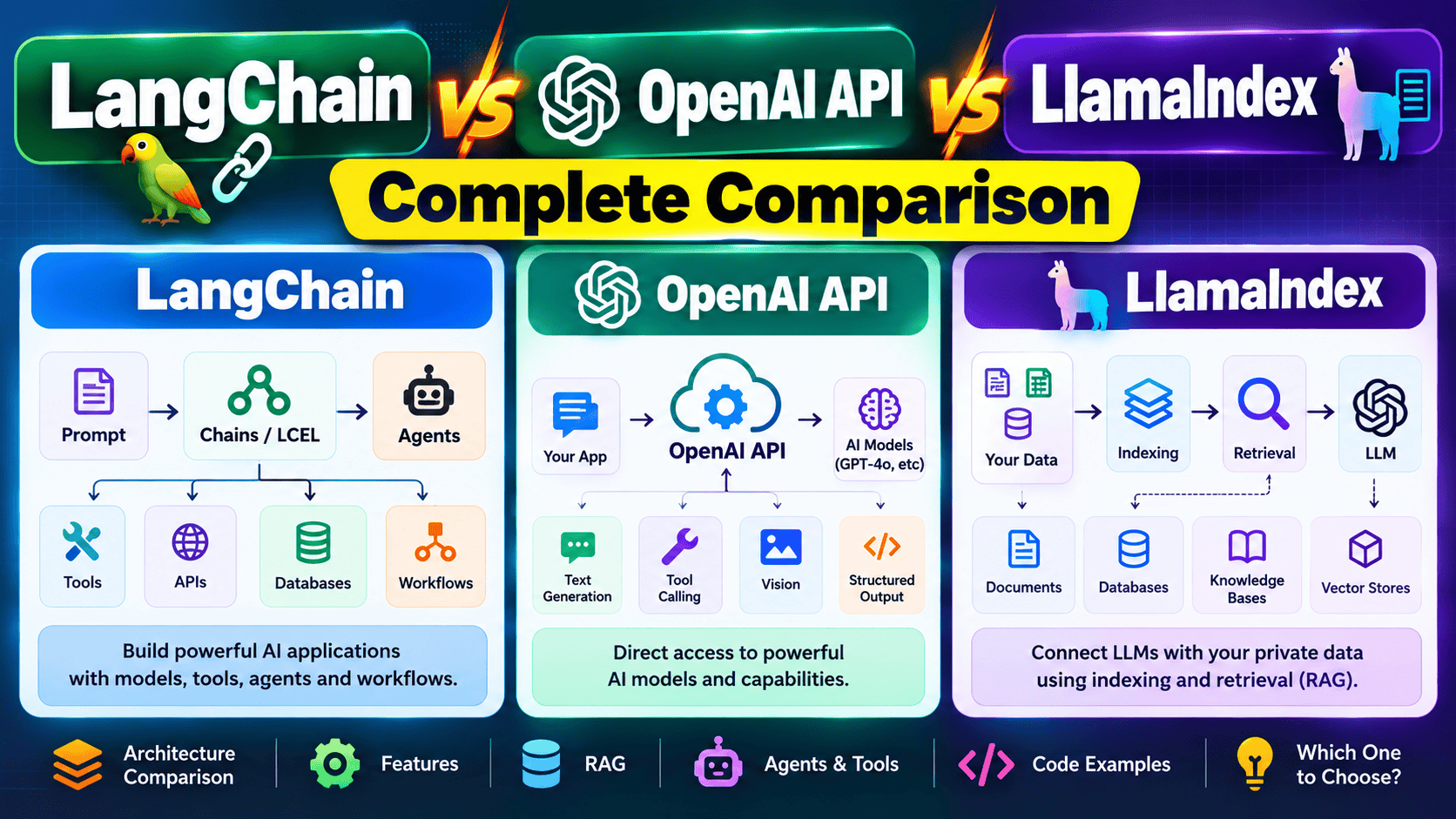
LangChain vs OpenAI API vs LlamaIndex: Complete Comparison
When building an AI application, you will quickly come across three popular choices: OpenAI API, LangChain, and LlamaIndex. Although they are often discussed together, they solve different problems.
The Main Difference
The easiest way to understand the difference is to look at their position in an AI application.
OpenAI API
Provides direct access to OpenAI models and capabilities. You control the application logic yourself.
LangChain
Provides abstractions for models, prompts, tools, agents, retrieval, workflows, and application orchestration.
LlamaIndex
Provides tools for connecting LLM applications to private data through indexing, retrieval, querying, and data connectors.
So the comparison is not exactly “which API is better?”. The more accurate question is: “Which layer of my AI application do I need?”
What Is the OpenAI API?
The OpenAI API is a direct way for developers to integrate OpenAI’s AI capabilities into their applications. You can send input to a model and receive generated output, while also using supported capabilities such as tool calling and other platform features.
The current OpenAI platform uses the Responses API for new integrations; the older Assistants API was sunset on August 26, 2026. :chatgpt-content-reference{index=”0″}
Simple Example
from openai import OpenAI

client = OpenAI()

response = client.responses.create(
    model="your-model",
    input="Explain LangChain in simple words."
)

print(response.output_text)
This approach is simple because you are working directly with the model provider. There is no additional orchestration framework between your application and the API unless you add one.
When OpenAI API Makes Sense
- Simple chat applications
- Text generation
- Structured output
- Classification
- Summarization
- Content generation
- Direct model interaction
- Applications using OpenAI-native capabilities
OpenAI API usage is billed according to model and tool usage. OpenAI publishes current model and tool pricing on its pricing page. :chatgpt-content-reference{index=”1″}
What Is LangChain?
LangChain is an application-development framework for building systems around language models. Instead of writing every integration and workflow manually, developers can use abstractions for models, prompts, tools, agents, retrieval, and application workflows.
One important advantage is that LangChain is not limited to one model provider. Its ecosystem contains integrations for providers such as OpenAI, Anthropic, Google, AWS, Hugging Face, Mistral and others. :chatgpt-content-reference{index=”2″}
Typical LangChain Components
Models
Connect your application to different language and multimodal model providers.
Prompts
Create reusable and structured prompts instead of keeping everything as raw strings.
Tools
Allow models or agents to interact with APIs, databases, search, calculators and custom functions.
Agents
Build systems where the model can decide which tools or actions should be used.
Retrieval
Connect your application to external knowledge and retrieve relevant information.
Workflows
Build multi-step AI workflows where different operations are executed in sequence.
What Is LlamaIndex?
LlamaIndex is a framework focused heavily on connecting LLM applications with external and private data. It is particularly useful when your AI application needs to understand documents, databases, files, knowledge bases, or other data sources.
This makes LlamaIndex especially interesting for RAG applications, document question-answering systems, knowledge assistants, and data-aware AI applications.
Typical LlamaIndex Components
- Data connectors
- Documents and nodes
- Indexes
- Embeddings
- Retrievers
- Query engines
- Response synthesis
- Agents and tools
- RAG pipelines
Architecture Comparison
The biggest conceptual difference becomes clear when we place all three into an application architecture.
Complete Feature Comparison
| Feature | OpenAI API | LangChain | LlamaIndex |
|---|---|---|---|
| Primary purpose | AI model access | AI application orchestration | Data + RAG applications |
| Category | AI platform / API | Application framework | Data framework |
| LLM provider | OpenAI | Multiple providers | Multiple providers |
| Prompt management | Yes | Strong | Yes |
| Chains / workflows | Build manually / API capabilities | Strong | Strong |
| RAG | Can use platform retrieval capabilities | Strong | Core strength |
| Document processing | Supported capabilities vary by API/tool | Good | Strong |
| Vector databases | Can integrate through APIs/tools | Many integrations | Strong RAG ecosystem |
| Agents | Native model/tool capabilities | Strong | Strong |
| Tool calling | Native model capability | Strong abstraction | Strong |
| Provider flexibility | Low | High | High |
| Learning curve | Low | Medium | Medium |
| Best for | Simple AI integrations | Complex AI applications | Knowledge and RAG applications |
LangChain vs LlamaIndex for RAG
RAG stands for Retrieval-Augmented Generation. It allows an AI application to retrieve relevant information from an external knowledge source before generating an answer.
Where LlamaIndex Stands Out
If the primary problem is: “I have a lot of private data and I want my AI application to search and answer questions about it,” LlamaIndex is a natural choice.
Where LangChain Stands Out
If the problem is: “I need a complete AI workflow involving models, tools, agents, APIs, databases and multiple steps,” LangChain can be a better fit.
Agents and Tool Calling
Modern AI applications often need more than generating text. An application may need to call a database, search the web, calculate something, call an API, or execute a custom function.
OpenAI API
The model can support tool/function calling, while your application is responsible for implementing the surrounding execution logic.
LangChain
LangChain provides abstractions for creating tools and agents and coordinating model-tool interactions.
LlamaIndex
LlamaIndex also supports agents and tools, especially when those tools operate over data and knowledge sources.
Code Comparison
1. Direct OpenAI API
from openai import OpenAI

client = OpenAI()

response = client.responses.create(
    model="your-model",
    input="What is RAG?"
)

print(response.output_text)
This is the most direct approach. You call the model and manage the rest of the application yourself.
2. LangChain
from langchain_openai import ChatOpenAI

model = ChatOpenAI(model="your-model")

response = model.invoke(
    "What is RAG?"
)

print(response.content)
The framework provides a consistent application-level abstraction around model interactions and can be extended into larger workflows.
3. LlamaIndex
from llama_index.core import VectorStoreIndex

index = VectorStoreIndex.from_documents(documents)

query_engine = index.as_query_engine()

response = query_engine.query(
    "What is RAG?"
)

print(response)
Here the focus is different: the application is querying information through an indexed data layer.
Performance and Complexity
A common misconception is that one of these frameworks automatically makes the AI model faster or smarter. That is generally not the right way to think about it.
OpenAI API
Lowest application-level abstraction. Fewer framework layers can mean simpler request paths and easier performance tuning.
LangChain
Adds useful abstractions and workflow logic. Complex workflows can introduce additional steps, but they also reduce development effort.
LlamaIndex
Adds data ingestion, indexing, retrieval and query layers. Performance depends heavily on the retrieval architecture and storage system.
In a RAG application, the vector database, embedding model, chunking strategy, retrieval method, network latency, model latency and amount of retrieved context can all have a major impact on performance.
Which One Should You Use?
Example: Simple Chatbot
For a simple chatbot that receives a question and returns an AI-generated response, using the OpenAI API directly may be enough.
Example: AI Agent
Suppose the AI needs to decide whether to search the web, query a database, call an API, or use a calculator. A framework such as LangChain can be useful for organizing that workflow.
Example: Company Knowledge Bot
Suppose a company has thousands of PDFs, policies, Excel files, product documents and internal knowledge. The primary challenge becomes data ingestion, indexing and retrieval.
Can You Use Them Together?
Yes. In fact, this is an important point. You do not necessarily have to choose only one.
A production AI application can combine the three technologies based on their strengths.
A Practical Architecture
User
  ↓
Laravel / React Application
  ↓
Python AI Service
  ↓
LangChain
  ├── Agent
  ├── Tools
  ├── Workflow
  └── Model Routing
        ↓
LlamaIndex
  ├── Documents
  ├── Indexes
  ├── Retrievers
  └── Vector Store
        ↓
OpenAI API
  ↓
LLM Response
  ↓
Python Service
  ↓
Laravel
  ↓
User
This architecture separates responsibilities instead of forcing one framework to do everything.
What About Database Queries?
Another common use case is allowing an AI assistant to answer questions from SQL databases.
For this type of system, LangChain can be useful for orchestrating the model, database tools and workflow. LlamaIndex can also be useful when the application combines structured data with broader knowledge retrieval. The OpenAI API provides the underlying model capabilities if OpenAI models are selected.
Advantages and Disadvantages
OpenAI API
- Simple to start
- Direct model access
- Less framework overhead
- Strong platform capabilities
LangChain
- Excellent workflow abstractions
- Large integration ecosystem
- Useful for agents and tools
- Provider flexibility
LlamaIndex
- Strong data integration
- Excellent for RAG
- Useful indexing abstractions
- Good knowledge-base workflows
When OpenAI API Is Better
- You want a simple architecture
- You only need model capabilities
- You want complete application control
- You do not need a large orchestration framework
When Direct API Becomes Harder
- Many tools
- Complex agent loops
- Multiple providers
- Large RAG pipelines
- Multi-step workflows
OpenAI API vs LangChain vs LlamaIndex: Simple Mental Model
Think
Orchestrate
Retrieve
This is not a strict technical rule, but it is a useful mental model for beginners.
Decision Guide
| Your Requirement | Recommended Starting Point | Why |
|---|---|---|
| Simple chatbot | OpenAI API | Minimal architecture |
| Text generation API | OpenAI API | Direct model access |
| Multiple AI providers | LangChain | Provider abstraction and integrations |
| AI agent with many tools | LangChain | Agent and workflow orchestration |
| PDF knowledge bot | LlamaIndex | Data ingestion and retrieval focus |
| Company knowledge base | LlamaIndex | Strong data/RAG architecture |
| Complex RAG + tools + agents | LangChain + LlamaIndex | Can separate orchestration from data retrieval |
| Maximum control | OpenAI API directly | You implement the architecture yourself |
What Should Beginners Learn First?
If you are completely new to AI development, learning everything at once can be confusing. A better approach is to learn the layers one by one.
First understand how an LLM API works. Then learn how applications retrieve external data. After that, learn frameworks such as LangChain and LlamaIndex to build larger systems.
Final Comparison
| Category | Winner | Reason |
|---|---|---|
| Ease of starting | OpenAI API | Very direct model integration |
| Model flexibility | LangChain / LlamaIndex | Designed for multiple providers |
| Complex workflows | LangChain | Strong orchestration abstractions |
| Agents and tools | LangChain | Strong application-level abstractions |
| RAG | LlamaIndex | Strong focus on data and retrieval |
| Simple AI API | OpenAI API | Less complexity |
| Data-heavy AI applications | LlamaIndex | Designed around connecting LLMs with data |
| Full AI application orchestration | LangChain | Broad workflow and integration ecosystem |
OpenAI API, LangChain, and LlamaIndex are not direct replacements for each other. OpenAI provides the model platform, LangChain helps orchestrate AI applications, and LlamaIndex focuses strongly on connecting AI systems to data.
For a simple application, the OpenAI API may be all you need. For complex AI workflows, LangChain becomes useful. For data-heavy RAG applications, LlamaIndex is particularly valuable. And for advanced production systems, you can combine them.
Frequently Asked Questions
Not exactly. OpenAI is an AI/model platform, while LangChain is an application framework that can work with OpenAI and other model providers.
Neither is universally better. LlamaIndex is especially attractive for data and RAG-heavy applications, while LangChain is particularly useful for broader AI workflows, agents and tool orchestration.
Yes. LangChain provides integrations for OpenAI models.
Yes. LlamaIndex can be used with OpenAI models as part of an AI application.
No. A simple chatbot can be built directly using an LLM provider’s API. A framework becomes more useful as the application’s complexity increases.
No. RAG can be implemented without LlamaIndex. However, LlamaIndex provides abstractions that can simplify data ingestion, indexing and retrieval workflows.
Yes. They can be combined when you want LangChain for application orchestration and LlamaIndex for specific data or retrieval responsibilities.
Start with direct LLM API usage and understand prompts, tokens, structured output and tool calling. Then learn RAG and frameworks such as LangChain and LlamaIndex.
Conclusion
The choice between OpenAI API vs LangChain vs LlamaIndex depends on what you are actually trying to build.
If you need direct access to an AI model, start with the OpenAI API. If you need complex workflows, agents, tools and integrations, consider LangChain. If your biggest challenge is connecting AI with documents, databases and private knowledge, consider LlamaIndex.
The most important lesson is that these technologies can complement each other rather than compete with each other. Understanding their roles will help you design cleaner, more scalable AI architectures.