
Linked List in Data Structures (DSA) – Complete Guide
Linked List in PHP (DSA)
🚀 Introduction
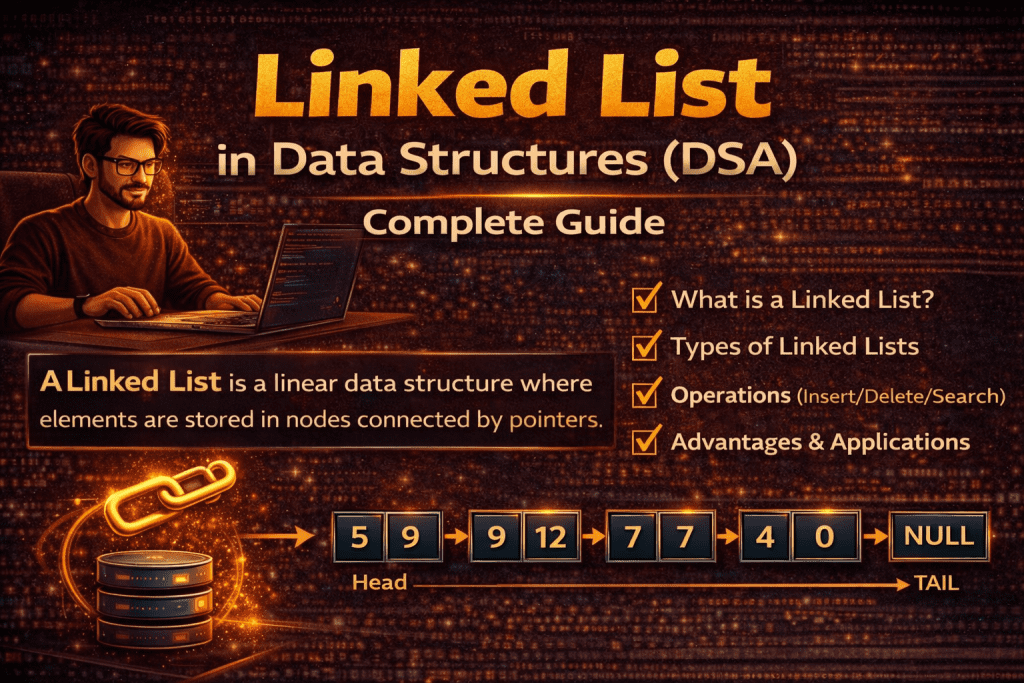
A Linked List is a linear data structure where elements (called nodes) are connected using pointers. Unlike arrays, linked lists are not stored in contiguous memory locations.
Each node contains:
- Data
- Reference (pointer) to the next node
👉 This makes insertion and deletion operations efficient.
📦 Types of Linked Lists
1️⃣ Singly Linked List
Each node points to the next node.
[Data | Next] → [Data | Next] → NULL
2️⃣ Doubly Linked List
Each node has two pointers:
- Previous
- Next
NULL ← [Prev | Data | Next] → [Prev | Data | Next] → NULL
3️⃣ Circular Linked List
The last node points back to the first node.
[Data] → [Data] → [Data]
   ↑__________________↓
⚙️ Basic Operations
- Insertion (beginning, end, position)
- Deletion
- Traversal
- Searching
🧑💻 PHP Implementation (Singly Linked List)
<?php
class Node {
    public $data;
    public $next;
    public function __construct($data) {
        $this->data = $data;
        $this->next = null;
    }
}
class LinkedList {
    public $head;

    public function __construct() {
        $this->head = null;
    }
        // Insert at beginning
    public function insertAtBeginning($data) {
        $newNode = new Node($data);
        $newNode->next = $this->head;
        $this->head = $newNode;
    }
        // Insert at end
    public function insertAtEnd($data) {
        $newNode = new Node($data);
        if ($this->head == null) {
            $this->head = $newNode;
            return;
        }
        $temp = $this->head;
        while ($temp->next != null) {
            $temp = $temp->next;
        }
        $temp->next = $newNode;
    }
       // Display the list
    public function display() {
        $temp = $this->head;
        while ($temp != null) {
            echo $temp->data . " -> ";
            $temp = $temp->next;
        }
        echo "NULL";
    }
}
// Example Usage
$list = new LinkedList();
$list->insertAtBeginning(10);
$list->insertAtEnd(20);
$list->insertAtEnd(30);$list->display();
?>⚡ Time Complexity
| Operation | Time Complexity |
|---|---|
| Insertion | O(1) / O(n) |
| Deletion | O(1) / O(n) |
| Search | O(n) |
| Traversal | O(n) |
🎯 Advantages
✅ Dynamic size (no fixed limit)
✅ Efficient insertion and deletion
✅ No memory reallocation like arrays
❌ Disadvantages
❌ No direct access (no indexing)
❌ Extra memory for pointers
❌ Slower traversal compared to arrays
🧠 Common Interview Questions
- Reverse a linked list
- Find the middle node
- Detect a loop (cycle detection)
- Merge two linked lists
- Remove the nth node from the end
🔥 Pro Tip
Most interview problems are based on:
- Two-pointer technique (fast & slow pointer)
- Recursion
- Dummy node approach
🏁 Conclusion
Linked Lists are a fundamental part of Data Structures and Algorithms. They are widely used in real-world applications such as:
- Memory management
- Graph implementations
- Undo/Redo systems
No comments yet! You be the first to comment.