
Deletion in Linked List (DSA) – Delete Node at Beginning, End & Position
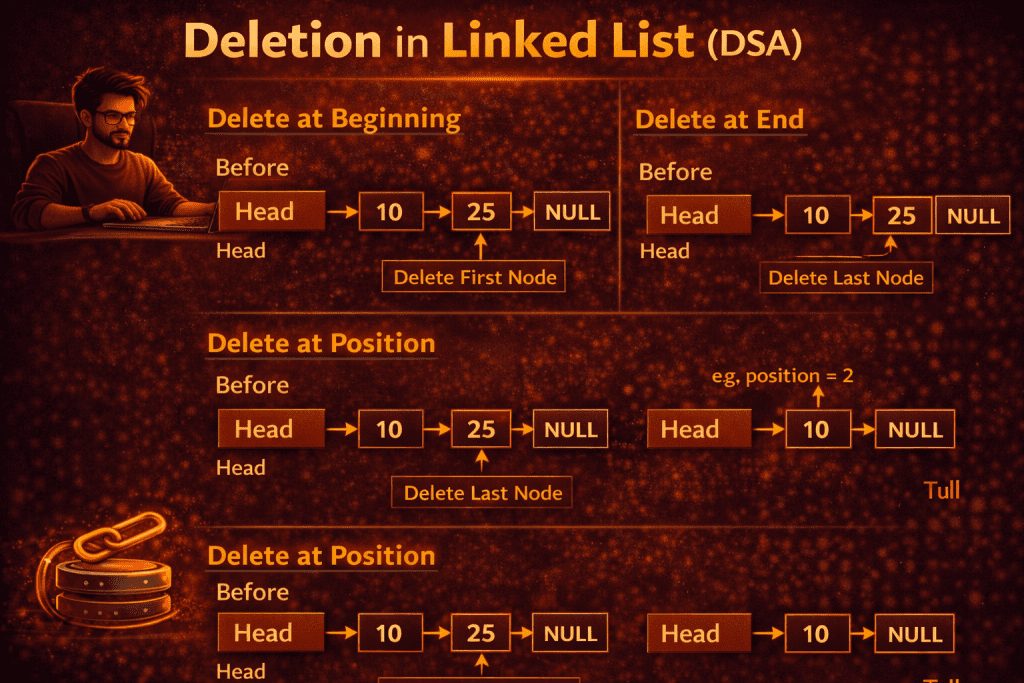
🚀 Introduction
Deletion in a Linked List means removing a node from the list by adjusting pointers.
👉 Unlike arrays, no shifting is required — only pointer updates.
🔹 Structure Reminder
[Data | Next] → [Data | Next] → NULL
🔹 Types of Deletion
- Delete from Beginning
- Delete from End
- Delete from Specific Position
🔹 1. Delete from Beginning
💡 Concept
- Move head to next node
- Delete old head
🧾 Example
Before:
10 → 20 → 30 → NULL
After deletion:
20 → 30 → NULL
⚙️ Algorithm
- Check if list is empty
- Store current head
- Move head to next
- Delete old node
⚡ Complexity
👉 O(1)
🔹 2. Delete from End
💡 Concept
- Traverse to second last node
- Set its next to NULL
🧾 Example
Before:
10 → 20 → 30 → NULL
After deletion:
10 → 20 → NULL
⚙️ Algorithm
- Traverse till second last node
- Set
temp.next = NULL
⚡ Complexity
👉 O(n)
🔹 3. Delete from Specific Position
💡 Concept
- Traverse to previous node
- Skip the node to delete
🧾 Example
Before:
10 → 20 → 30 → 40 → NULL
Delete position 3:
After:
10 → 20 → 40 → NULL
⚙️ Algorithm
- Traverse to position – 1
- Store node to delete
- Link previous node to next node
⚡ Complexity
👉 O(n)
🧑💻 PHP Implementation
<?phpclass Node {
    public $data;
    public $next;    public function __construct($data) {
        $this->data = $data;
        $this->next = null;
    }
}class LinkedList {
    public $head;    // Delete from beginning
    public function deleteFromBeginning() {
        if ($this->head == null) return;        $this->head = $this->head->next;
    }    // Delete from end
    public function deleteFromEnd() {
        if ($this->head == null) return;        if ($this->head->next == null) {
            $this->head = null;
            return;
        }        $temp = $this->head;
        while ($temp->next->next != null) {
            $temp = $temp->next;
        }        $temp->next = null;
    }    // Delete from position
    public function deleteAtPosition($position) {
        if ($this->head == null) return;        if ($position == 1) {
            $this->head = $this->head->next;
            return;
        }        $temp = $this->head;
        for ($i = 1; $i < $position - 1 && $temp->next != null; $i++) {
            $temp = $temp->next;
        }        if ($temp->next == null) return;        $temp->next = $temp->next->next;
    }
}?>
⚡ Time Complexity Summary
| Operation | Complexity |
|---|---|
| Delete Beginning | O(1) |
| Delete End | O(n) |
| Delete Position | O(n) |
🎯 Key Points
✅ No shifting like arrays
✅ Only pointer manipulation
✅ Efficient deletion
No comments yet! You be the first to comment.