
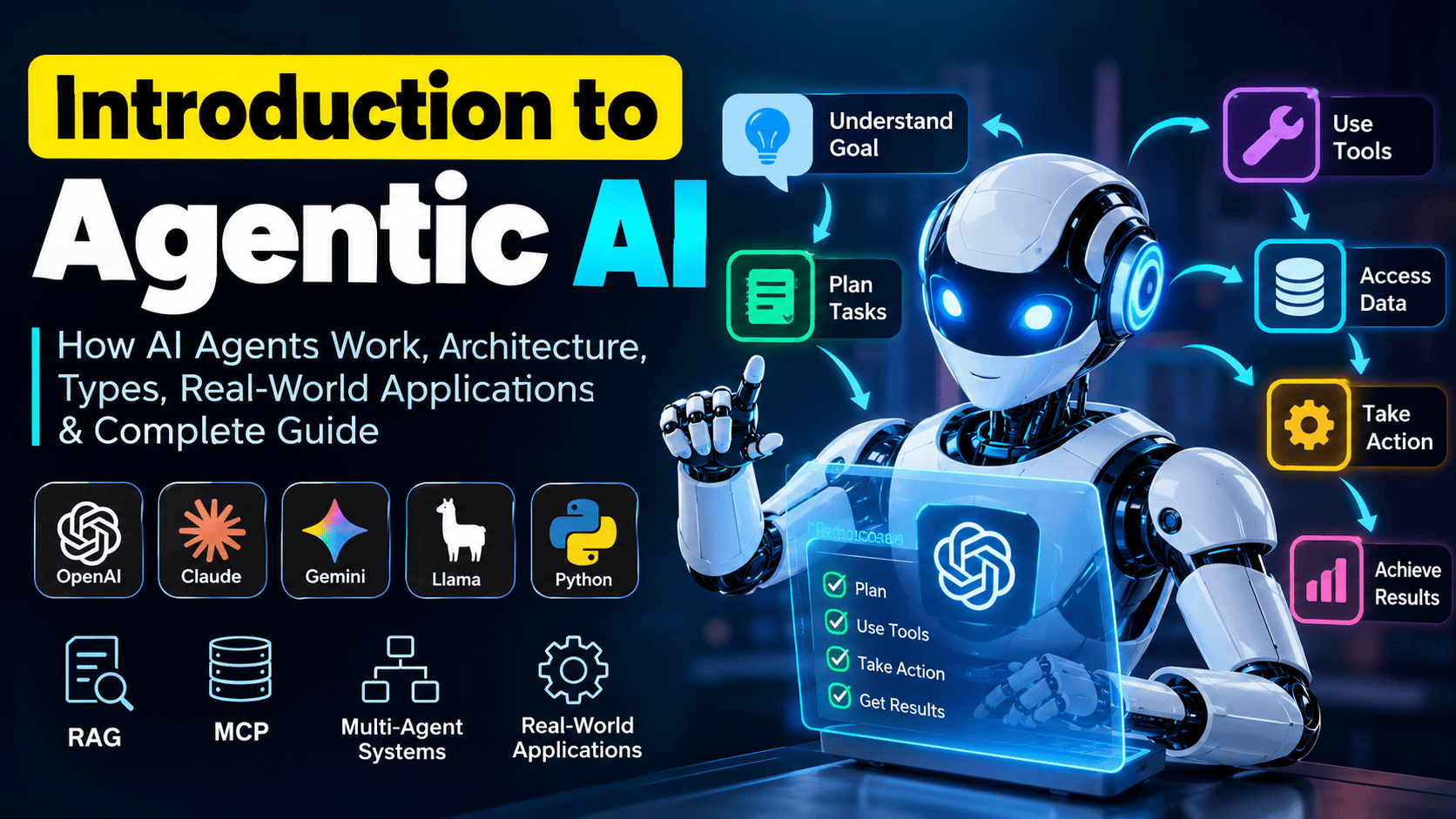
Introduction to Agentic AI: How It Works, Types, Architecture & Applications
1. Introduction to Agentic AI
Artificial Intelligence (AI) is evolving rapidly, moving beyond systems that simply generate text, images, or answers toward systems that can independently perform tasks, make decisions, and achieve specific goals. One of the most significant developments in this area is Agentic AI.
Agentic AI refers to AI systems that can understand objectives, plan actions, use external tools, make decisions, and evaluate results with limited human intervention. Unlike traditional AI applications that primarily respond to user instructions, Agentic AI systems can execute multi-step workflows to accomplish a particular objective.
For example, a traditional chatbot can explain how to track an order. An Agentic AI system can identify the order, retrieve its status through an API, check delivery information, and provide the customer with an updated response.
Agentic AI is becoming increasingly important in customer support, software development, business automation, data analytics, finance, and many other industries.
2. What Is Agentic AI?
Agentic AI is an approach to building AI systems that can pursue defined goals by combining reasoning, planning, memory, tool usage, and action execution.
An Agentic AI system generally follows a cycle:
- Perception: Understand the user’s request and available information.
- Reasoning: Determine what needs to be done.
- Planning: Break the objective into smaller tasks.
- Action: Execute tasks using available tools and integrations.
- Observation: Review the results of those actions.
- Evaluation: Determine whether the objective has been achieved or whether additional steps are required.
This process allows AI systems to perform complex tasks that may involve multiple decisions and interactions with external applications.
Example of Agentic AI
Imagine a customer asks:
“Where is my order, and when will it arrive?”
A traditional AI chatbot might provide instructions for checking an order.
An Agentic AI system could:
- Identify the customer’s order using authenticated account information.
- Retrieve the order details from a database.
- Call a shipping API to check the delivery status.
- Evaluate the returned information.
- Provide the expected delivery date to the customer.
- Escalate the issue if the shipping information is unavailable.
The key difference is that Agentic AI can take actions through connected tools rather than simply generating a response.
3. What Is an AI Agent?
An AI Agent is a software system that uses artificial intelligence to observe information, make decisions, and perform actions to achieve a specific goal.
An AI Agent commonly consists of several components:
- LLM: Processes natural language, interprets requests, and helps make decisions.
- Instructions: Define the agent’s role, objectives, and operating rules.
- Tools: Allow the agent to interact with databases, APIs, search engines, and other systems.
- Memory: Maintains relevant context and information.
- Planning: Determines the steps required to complete a task.
- Action Execution: Performs operations through connected tools.
- Feedback: Evaluates results and determines the next step.
Not every AI Agent needs all these components. Simple agents may use only an LLM and a small number of tools, while more advanced systems may include persistent memory, planning, evaluation, and multiple specialized agents.
4. How Does Agentic AI Work?
Agentic AI typically operates through a continuous cycle of reasoning and action, often referred to as the Agent Loop.
Step 1: Receive a Goal
The process begins when a user provides a goal or task.
For example:
“Generate a monthly sales report and identify the best-performing products.”
The agent receives the request and determines the expected outcome.
Step 2: Understand and Reason
The AI model interprets the request and identifies the information and operations required.
It may determine that it needs to retrieve sales data, calculate revenue, compare product performance, and generate a summary.
Step 3: Create a Plan
The agent breaks the main task into smaller steps.
A possible plan could be:
- Retrieve sales records for the requested month.
- Group sales by product.
- Calculate total revenue.
- Compare performance across products.
- Identify the best-performing products.
- Generate the final report.
Step 4: Select and Use Tools
The agent selects appropriate tools based on the task.
These may include:
- SQL queries for retrieving data.
- REST APIs for external information.
- Python for calculations and data processing.
- RAG for retrieving relevant documents.
- File-generation tools for producing reports.
The application executes the selected tool after validating the request and checking the relevant permissions.
Step 5: Observe Results
After executing a tool, the agent receives its output.
For example, a database tool may return sales records, or an API may return customer information.
The agent uses the results to determine whether it can proceed.
Step 6: Evaluate and Repeat
If the information is incomplete, the agent may select another tool, revise its plan, or retry an operation within defined limits.
If the task cannot be completed, the system should provide a clear explanation or request human assistance.
Step 7: Generate the Final Response
Once the necessary work is complete, the agent generates a response based on the verified results.
This approach enables AI systems to handle multi-step tasks more effectively than a simple question-and-answer workflow.
5. Key Components of Agentic AI
5.1 Large Language Models (LLMs)
Large Language Models are the core language-processing components of many modern AI Agents.
Popular LLMs include:
- OpenAI GPT
- Anthropic Claude
- Google Gemini
- Meta Llama
- DeepSeek
LLMs can understand natural language, interpret instructions, select tools, process tool results, and generate responses.
However, an LLM alone is not necessarily an AI Agent. An agent requires additional application logic, tools, and a mechanism for controlling actions.
5.2 Prompt Engineering
Prompt Engineering is the process of creating instructions that guide an AI model’s behavior.
For example, a customer-support agent may be given instructions to:
- Answer questions using an approved knowledge base.
- Retrieve order information only through authorized tools.
- Never invent customer or order details.
- Request clarification when information is insufficient.
- Escalate unresolved cases to a human representative.
Well-designed instructions help improve consistency, reliability, and adherence to business rules.
Important prompt engineering concepts include system prompts, few-shot prompting, structured outputs, context engineering, and prompt injection defense.
5.3 Reasoning and Decision-Making
Reasoning enables an AI Agent to evaluate available information and determine appropriate next steps.
For example, when processing a refund request, an agent may need to:
- Identify the customer’s order.
- Check the refund policy.
- Verify the purchase date.
- Determine whether the order meets refund conditions.
- Request approval when required.
Reasoning does not guarantee that every decision will be correct. Important business decisions should be verified using deterministic rules, authoritative data, or human approval.
5.4 Planning
Planning allows an AI Agent to divide a complex objective into smaller tasks.
Common planning approaches include:
- Sequential Planning
- Goal-Based Planning
- Hierarchical Planning
- Dynamic Planning
- Task Decomposition
- Replanning
- Task Prioritization
Planning is especially useful for workflows that require several tools or depend on the results of earlier operations.
5.5 Tool Calling
Tool Calling allows an AI model to request the execution of external functions.
For example, an AI Agent may use tools to:
- Retrieve customer information.
- Search a database.
- Create a support ticket.
- Send an approved email.
- Calculate financial metrics.
- Retrieve information from an external API.
The AI model generally selects a tool and supplies structured arguments. The application validates the request, checks permissions, executes the function, and returns the result.
Tool Calling is one of the most important capabilities in modern Agentic AI systems because it connects language models to real-world applications.
5.6 Memory
Memory enables AI Agents to maintain relevant information during a task or across conversations.
Common memory types include:
- Short-Term Memory: Stores information relevant to the current conversation.
- Long-Term Memory: Persists useful information across sessions.
- Episodic Memory: Stores records of previous interactions or experiences.
- Semantic Memory: Stores facts, concepts, and knowledge.
- Working Memory: Holds information required for the current task.
Memory should be designed carefully to avoid storing unnecessary, sensitive, or inaccurate information.
5.7 Feedback and Evaluation
Feedback and evaluation help an agent determine whether an operation has produced the expected result.
An agent may evaluate:
- Whether an API request succeeded.
- Whether a database returned the expected records.
- Whether retrieved information is relevant.
- Whether the task meets predefined requirements.
- Whether human review is necessary.
Evaluation can use deterministic validation, model-based assessment, automated tests, and human feedback.
6. Types of AI Agents
AI Agents can be categorized according to how they make decisions and achieve goals.
6.1 Simple Reflex Agents
Simple Reflex Agents make decisions based on predefined rules and the current input.
For example, a ticket-management system may automatically assign high-priority tickets to a specific support queue.
These agents are generally suitable for predictable tasks with clearly defined rules.
6.2 Model-Based Agents
Model-Based Agents maintain an internal representation of relevant information about their environment.
For example, a troubleshooting agent may track which diagnostic steps have already been completed and use that information to determine what to do next.
6.3 Goal-Based Agents
Goal-Based Agents select actions according to a defined objective.
For example, a scheduling agent may search for an available meeting slot that satisfies the participants’ requirements.
6.4 Utility-Based Agents
Utility-Based Agents evaluate possible actions according to a utility function that represents desired outcomes or trade-offs.
For example, a delivery-planning system may balance cost, delivery time, and route efficiency.
6.5 Learning Agents
Learning Agents improve their behavior through learning processes, feedback, or updated models.
For example, a recommendation system may adapt its recommendations based on user interactions.
These categories originate from classical AI. Modern LLM-based agents may combine characteristics from multiple categories.
7. Single-Agent vs. Multi-Agent Systems
Agentic AI systems can be designed using one agent or multiple collaborating agents.
Single-Agent System
A Single-Agent System uses one primary agent to manage a task and interact with different tools.
For example, a customer-support agent may retrieve order information, search the knowledge base, and create support tickets using different tools.
Advantages include:
- Simpler architecture.
- Lower coordination overhead.
- Easier debugging.
- Fewer inter-agent communication failures.
- Often lower operational costs.
Multi-Agent System
A Multi-Agent System uses multiple specialized agents that collaborate to achieve a shared objective.
For example, a business reporting system may include:
- Research Agent: Retrieves relevant business information.
- Data Analysis Agent: Processes and analyzes datasets.
- Reporting Agent: Generates reports.
- Coordinator Agent: Assigns tasks and combines the results.
Multi-Agent Systems can be useful when tasks have distinct responsibilities, but they introduce additional complexity, communication overhead, and potential failure points.
For many applications, a well-designed single agent with reliable tools is sufficient.
8. Agentic AI Architecture
A typical Agentic AI architecture contains several layers that work together.
User Interface Layer
This is where users interact with the AI system through web applications, mobile applications, chat interfaces, or messaging platforms.
Technologies may include React, Next.js, Vue.js, and other frontend frameworks.
API and Authentication Layer
This layer manages incoming requests, user authentication, authorization, tenant isolation, and rate limiting.
Frameworks such as Laravel, FastAPI, and Django can be used to build this layer.
Agent Orchestration Layer
The orchestration layer coordinates the agent’s operations, including:
- LLM interaction.
- Task planning.
- Tool selection.
- Memory management.
- State transitions.
- Evaluation.
- Error handling.
Tools and Integration Layer
This layer connects the agent to external systems such as databases, REST APIs, CRMs, document repositories, and search engines.
Data and Infrastructure Layer
This layer manages the data and infrastructure required by the application.
It may include:
- MySQL
- PostgreSQL
- Redis
- Vector Databases
- Object Storage
- Message Queues
- Logging and Monitoring Systems
The exact architecture depends on the application’s requirements, security model, scale, and complexity.
9. Agentic AI vs. Generative AI
Generative AI and Agentic AI are closely related but serve different purposes.
| Feature | Generative AI | Agentic AI |
|---|---|---|
| Primary Purpose | Generate content | Achieve defined goals through actions |
| Text Generation | Yes | Usually |
| Reasoning | Model-dependent | Used to guide actions |
| Tool Usage | Optional | Common |
| Planning | Not required | Often supported |
| Multi-Step Tasks | Usually user-directed | Can be coordinated by the agent |
| External Actions | Usually through integrations | Central to many agentic workflows |
| Autonomy | Often limited | Can be configured from low to high |
Generative AI focuses on producing content, whereas Agentic AI focuses on accomplishing objectives using reasoning, tools, and controlled execution.
Generative AI can be a component of an Agentic AI system.
10. RAG in Agentic AI
Retrieval-Augmented Generation (RAG) is a technique that allows AI applications to retrieve relevant information from external data sources and use it when generating responses.
RAG is particularly useful when an AI Agent needs access to private business information, product documentation, company policies, or large knowledge bases.
A typical RAG workflow includes:
- Collecting documents from relevant sources.
- Splitting documents into smaller chunks.
- Generating embeddings.
- Storing embeddings in a vector database.
- Converting a user query into a retrieval request.
- Retrieving relevant information.
- Providing the retrieved context to the LLM.
- Generating a grounded response.
What Is Agentic RAG?
Agentic RAG extends conventional retrieval workflows by allowing an agent to make decisions about information retrieval.
For example, an agent may:
- Decide whether retrieval is necessary.
- Select an appropriate knowledge source.
- Refine a search query.
- Retrieve additional documents when needed.
- Evaluate whether the retrieved context is relevant.
- Produce an answer based on verified information.
RAG is a retrieval technique, while Agentic RAG incorporates agent-driven decisions into the retrieval process.
11. Model Context Protocol (MCP)
Model Context Protocol (MCP) is an open protocol that standardizes how AI applications connect to external tools and context sources.
MCP can help AI applications interact with databases, file systems, APIs, and other services through compatible servers.
MCP commonly provides three capabilities:
- Tools: Functions that an AI application can invoke.
- Resources: Data or context that can be retrieved.
- Prompts: Reusable prompt templates.
For example, an AI Agent may connect to an MCP server that exposes tools for searching documents or retrieving authorized database records.
MCP simplifies integrations, but it does not replace the need for application-level security, access controls, and validation.
12. Popular Agentic AI Frameworks
Several frameworks and development tools help developers build Agentic AI applications.
| Framework | Description |
|---|---|
| LangChain | Framework for building LLM applications and tool-using agents |
| LangGraph | Framework for stateful and controllable agent workflows |
| OpenAI Agents SDK | Toolkit for building agents with tools, handoffs, and tracing |
| CrewAI | Framework for coordinating role-based agents |
| AutoGen | Framework for building conversational multi-agent applications |
| LlamaIndex | Framework for data-centric LLM applications and agents |
| Semantic Kernel | SDK for integrating AI orchestration into applications |
| PydanticAI | Python framework for type-safe AI applications |
| n8n | Workflow automation platform with AI integrations |
The best framework depends on the use case. Developers should select a framework based on control requirements, maintainability, integrations, observability, and deployment needs rather than choosing one simply because it is popular.
13. Real-World Applications of Agentic AI
13.1 Customer Support Automation
Agentic AI can automate various customer-support operations.
Potential capabilities include:
- Understanding customer requests.
- Retrieving account information.
- Searching company knowledge bases.
- Checking order status.
- Creating support tickets.
- Escalating complex cases.
13.2 Software Development
Software development agents can assist developers with:
- Understanding requirements.
- Generating code.
- Explaining existing code.
- Identifying potential bugs.
- Running tests.
- Suggesting code improvements.
- Preparing pull request drafts.
Code execution and repository modifications should be controlled through appropriate permissions and review processes.
13.3 Business Intelligence
Agentic AI can help organizations interact with their business data.
Examples include:
- Retrieving data from authorized databases.
- Analyzing sales performance.
- Generating reports.
- Identifying trends.
- Explaining business metrics.
- Detecting potential anomalies.
13.4 Sales and Marketing
Sales and marketing agents can support:
- Lead qualification.
- CRM data retrieval.
- Customer segmentation.
- Follow-up drafting.
- Campaign performance analysis.
- Sales reporting.
Actions such as sending messages or changing customer records should follow explicit business rules and approval requirements.
13.5 Finance and Accounting
Agentic AI can assist with:
- Transaction categorization.
- Expense analysis.
- Financial reporting.
- Invoice processing.
- Reconciliation support.
- Identifying records that require review.
Financial decisions and high-impact operations should include suitable human oversight and independent validation.
13.6 Healthcare Administration
In healthcare administration, AI agents may support appointment scheduling, document organization, administrative workflows, and information retrieval.
Sensitive patient information requires strict privacy and security controls, and clinical decisions must remain under qualified professional oversight.
14. Advantages of Agentic AI
Agentic AI offers several potential advantages when implemented for suitable use cases.
Workflow Automation: Agents can coordinate multiple steps and reduce repetitive manual operations.
Tool Integration: AI Agents can connect language models to existing business applications and services.
Task Decomposition: Complex goals can be divided into smaller tasks that are easier to execute and verify.
Context-Aware Operations: Agents can use relevant data and previous task results to determine subsequent actions.
Scalability: Well-designed systems can automate repetitive workflows across multiple users and business processes.
Improved Productivity: Employees can spend less time on routine work and more time on tasks that require human judgment.
The actual benefits depend on the reliability of the agent, quality of the data, workflow design, and operational controls.
15. Challenges and Limitations of Agentic AI
Despite its capabilities, Agentic AI introduces several important challenges.
Accuracy and Hallucinations
LLMs may produce incorrect information, misinterpret instructions, or select inappropriate tools.
Security Risks
Agents that access external systems can introduce risks such as unauthorized access, prompt injection, and unintended data disclosure.
Operational Costs
Multiple model calls, retrieval operations, and tool executions can increase infrastructure and API expenses.
Latency
Multi-step agent workflows can be slower than direct API calls or conventional application logic.
Debugging Complexity
When an agent makes multiple decisions and tool calls, identifying the source of a failure can be difficult.
Unpredictable Behavior
LLM-based decisions may vary across similar requests, so deterministic controls are important for business-critical operations.
Data Privacy
Agents may handle sensitive business or customer information, requiring careful data access policies, retention controls, and audit logging.
These limitations make it important to define appropriate levels of autonomy and establish safeguards before deploying agents in production.
16. Security and Guardrails in Agentic AI
Security is essential when an AI Agent interacts with databases, external APIs, or business systems.
Important security practices include:
- Authentication and authorization.
- Role-based access control.
- Tenant-level data isolation.
- Parameterized database queries.
- Tool allowlists.
- Input and output validation.
- Prompt injection defenses.
- Human approval for sensitive actions.
- Rate limiting and execution timeouts.
- Audit logging and monitoring.
- Restricted credentials and least-privilege access.
An AI Agent should not be trusted to enforce its own security policies. The application must independently validate each requested action and enforce permissions before execution.
17. How to Build an Agentic AI Application
Developers can build an Agentic AI application using a combination of a programming language, an LLM API, an agent framework, and external tools.
A typical development process involves the following steps.
Step 1: Define the Objective
Identify the task the agent is expected to perform, its inputs, expected outputs, and operational boundaries.
Step 2: Select an LLM
Choose a suitable language model based on reasoning capabilities, cost, latency, context requirements, and available integrations.
Step 3: Create Instructions
Define the agent’s role, objectives, tool-use rules, and expected response format.
Step 4: Integrate Tools
Create approved functions for database access, API requests, document retrieval, calculations, and other necessary operations.
Step 5: Implement the Agent Loop
Build the execution process that manages model responses, tool calls, tool results, and task completion.
Step 6: Add Memory and Retrieval
Add conversation state, relevant long-term memory, or RAG where the use case requires them.
Step 7: Implement Security
Enforce authentication, permissions, argument validation, execution limits, and human approval for sensitive operations.
Step 8: Test and Evaluate
Test the agent with normal requests, ambiguous queries, unexpected inputs, tool failures, and security scenarios.
Step 9: Deploy and Monitor
Deploy the application with logging, tracing, monitoring, error handling, and cost controls.
Step 10: Improve Iteratively
Use evaluation results and user feedback to improve the agent’s tools, instructions, retrieval quality, and workflow.
18. Agentic AI with Laravel and Python
Developers can integrate Agentic AI into existing Laravel applications by using Python as a separate agent engine.
For example, Laravel can manage:
- User authentication.
- Business logic.
- Tenant permissions.
- User interfaces.
- Existing MySQL databases.
A Python FastAPI service can manage:
- LLM communication.
- Agent orchestration.
- Tool calling.
- RAG pipelines.
- Memory.
- Agent evaluation.
Laravel can communicate with Python through authenticated HTTP APIs. The Python service can access approved business data using carefully restricted database credentials or through authorized Laravel endpoints.
This architecture allows businesses to add AI capabilities without replacing their existing backend applications.
For security, the Python agent should only receive the minimum data and permissions required for its tasks.
19. Agentic AI Learning Roadmap
Developers who want to build Agentic AI applications should consider learning the following topics in sequence:
Foundations
- Artificial Intelligence Fundamentals
- Machine Learning Basics
- Generative AI
- Large Language Models
- Transformers
- Tokens and Context Windows
LLM Development
- Prompt Engineering
- Context Engineering
- LLM APIs
- Structured Outputs
- Function Calling
- Embeddings
Agent Fundamentals
- AI Agents
- Agent Loop
- Reasoning
- Planning
- Task Decomposition
- Memory
- Tool Calling
- Feedback and Evaluation
Agent Frameworks
- LangChain
- LangGraph
- OpenAI Agents SDK
- CrewAI
- Multi-Agent Systems
- Agent Orchestration
Knowledge and Retrieval
- RAG
- Vector Databases
- Semantic Search
- Hybrid Search
- Reranking
- Agentic RAG
- SQL Agents
Advanced Concepts
- Model Context Protocol
- Multi-Agent Coordination
- Human-in-the-Loop
- Agent Evaluation
- Guardrails
- Observability
- Agent Security
Production Development
- FastAPI
- Database Integration
- Authentication
- Authorization
- Background Tasks
- Caching
- Logging
- Monitoring
- Deployment
- Performance Optimization
20. Future of Agentic AI
Agentic AI is an evolving area of artificial intelligence with potential applications across many industries.
As LLMs, tool integrations, orchestration frameworks, and evaluation methods improve, AI systems may become increasingly capable of managing complex business workflows.
Potential developments include:
- More reliable tool use.
- Better planning and task coordination.
- More effective multi-agent collaboration.
- Improved memory management.
- Stronger security and governance.
- Greater integration with enterprise software.
- More transparent evaluation and monitoring.
However, higher autonomy does not automatically mean higher reliability. Human oversight, trustworthy data, and secure execution will continue to play an important role in production systems.
21. Conclusion
Agentic AI represents an important evolution in AI application development. By combining large language models with planning, memory, tools, feedback, and controlled execution, developers can create systems that do more than generate answers.
From customer support and data analytics to software development and business automation, Agentic AI offers opportunities to automate complex, multi-step workflows.
To build reliable Agentic AI applications, developers should understand LLMs, tool calling, agent loops, RAG, orchestration frameworks, MCP, security, and evaluation.
The most effective way to learn Agentic AI is through practical projects. Start with a simple single-agent application, integrate a few safe tools, measure its performance, and gradually expand its capabilities as reliability improves.
Agentic AI is not just about making AI smarter; it is about building AI systems that can take useful, controlled, and verifiable actions toward specific goals.