
Agentic AI vs Generative AI: Key Differences, Examples, Benefits, and Future
Introduction
Artificial Intelligence is moving beyond simply answering questions and generating content. Modern AI applications can now connect to databases, interact with APIs, analyze business information, and execute multi-step tasks.
This has brought two important AI approaches into focus: Generative AI and Agentic AI.
Although both can use the same Large Language Models (LLMs), the way they handle tasks is significantly different.
Imagine you are building an AI chatbot for an e-commerce website. A customer asks:
“Find my order, check why it is delayed, and notify me when it will arrive.”
A Generative AI application can understand the question and generate a response based on the information provided to it. However, without tools or integrations, it cannot independently retrieve the order or check its latest status.
An Agentic AI application can be designed to retrieve the order from a database, check the shipping API, evaluate the available information, and prepare a response. If permitted, it could also initiate an approved notification workflow.
The difference is not simply that one generates content and the other performs actions. It is about how the entire application is designed to interpret a request, decide what to do, use external systems, and verify the outcome.
In this article, we will compare Agentic AI and Generative AI through practical examples, technical architecture, development workflows, and real-world applications.
1. The Core Difference Between Agentic AI and Generative AI
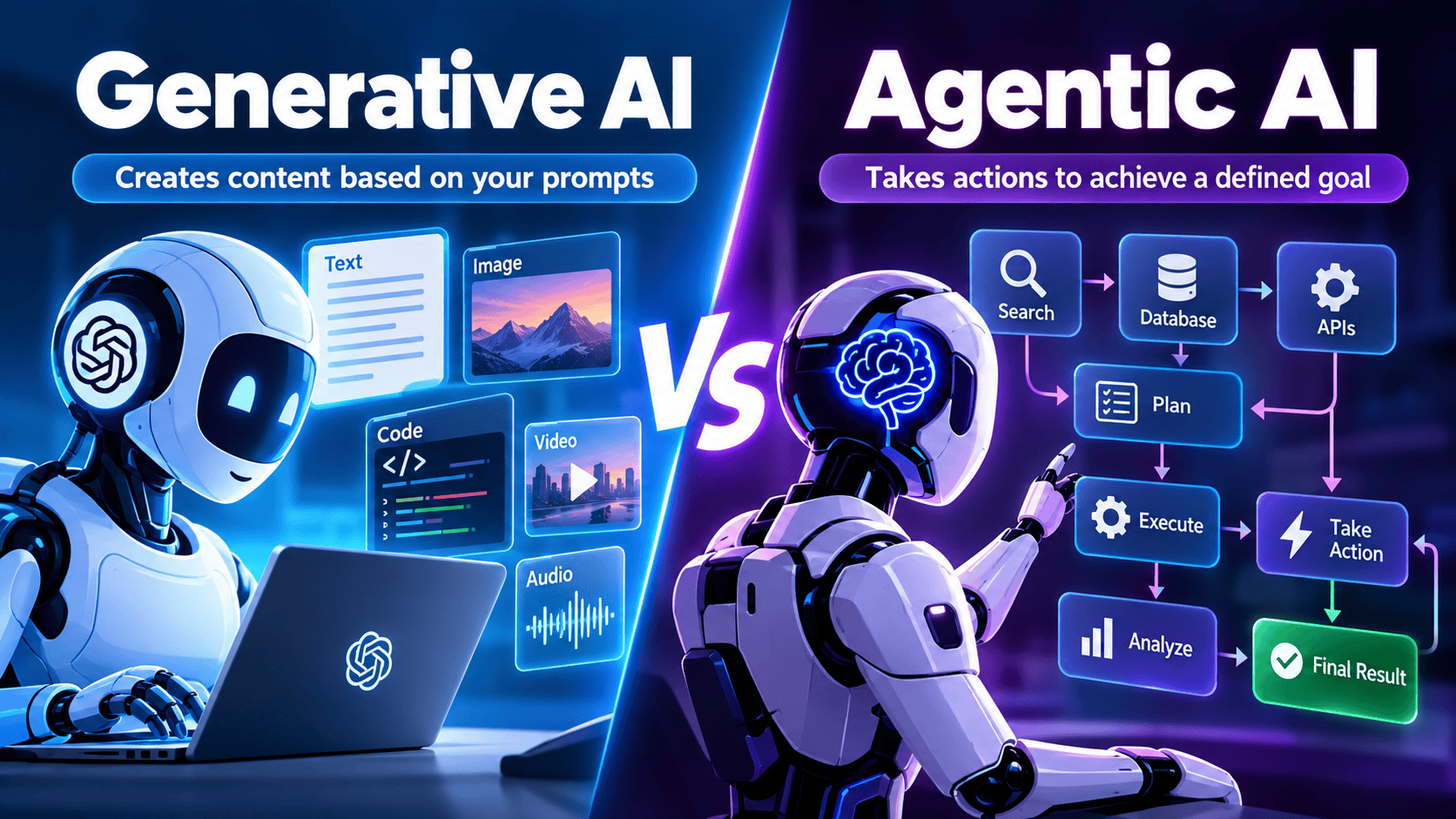
Generative AI is primarily designed to generate content or responses from a given input. Agentic AI is designed to work toward a goal by selecting actions, using tools, and evaluating results.
Consider the following example.
User request: “Analyze my company’s sales for September and identify the top five products.”
Generative AI approach:
- Receives the sales data from the user or application.
- Analyzes the available information.
- Generates a summary of the top five products.
- Returns the result as text, a table, or a report.
Agentic AI approach:
- Interprets the user’s objective.
- Determines which sales data is required.
- Selects an authorized database tool.
- Retrieves the September sales records.
- Calculates product performance.
- Checks the results and identifies the top five products.
- Generates a report and returns it to the user.
The Agentic AI application may use Generative AI for interpreting the request and writing the report. Its agent architecture coordinates the actual workflow.
2. Agentic AI vs Generative AI: Detailed Comparison
| Comparison | Generative AI | Agentic AI |
|---|---|---|
| Main objective | Generate content and responses | Complete a defined goal |
| Operating approach | Prompt-response or content generation | Goal-oriented execution |
| Input | Prompts, instructions, and context | Goals, instructions, and available context |
| Processing | Generates likely outputs based on learned patterns | Plans and selects steps using models, rules, or both |
| Output | Text, code, images, audio, and other content | Actions, decisions, completed workflows, and content |
| Autonomy | Usually responds to a prompt | Can execute multiple steps without a new prompt |
| Planning | Not inherently required | Often includes task planning |
| Tool integration | Optional | Commonly a core capability |
| Database access | Requires integration | Can use authorized database tools |
| Memory | Can use conversation context or external memory | Can use task state and optional persistent memory |
| Feedback | Can regenerate or revise outputs | Can observe outcomes and choose subsequent actions |
| Error handling | Usually provides a revised answer when prompted | Can detect failures, retry, recover, or escalate |
| Workflow | Often a single generation task | Usually a multi-step process |
| Human involvement | User generally provides prompts and reviews results | Human approval can be built into critical steps |
| Complexity | Depends on model and application | Includes additional orchestration and execution complexity |
| Best suited for | Writing, summarizing, generating, explaining | Automating workflows, using tools, achieving objectives |
Important: These are typical design differences, not absolute boundaries. A Generative AI application can use tools, and an Agentic AI system can generate content. The distinction is mainly in the overall workflow and level of task execution.
3. Same Task, Different Approach
The easiest way to understand the difference is to give both systems the same business task.
Example: Employee Attendance Management
Suppose a company wants to analyze employee attendance and identify employees with frequent absences.
With Generative AI
The application provides attendance records to the model.
The model can:
- Summarize attendance data.
- Identify patterns in the provided records.
- Generate an employee attendance report.
- Explain possible reasons for attendance trends if supporting information is provided.
The application must supply the data and handle any required external operations.
With Agentic AI
The system receives a goal: “Prepare this month’s attendance report.”
It can be designed to:
- Identify the reporting month.
- Connect to an authorized attendance API or database tool.
- Retrieve the relevant attendance records.
- Calculate attendance percentages and absence counts.
- Identify records that need review.
- Generate a report.
- Save the report to an approved location or request authorization before distributing it.
The agent is not automatically entitled to access employee records or make employment decisions. Database permissions, privacy controls, and human oversight must be enforced.
Example: Programming
Suppose a developer asks:
“Fix the login error in my Laravel project.”
| Generative AI | Agentic AI |
|---|---|
| Explains the likely cause of the error | Inspects the available project files |
| Suggests corrected PHP code | Identifies relevant files and dependencies |
| Generates a controller or query | Proposes or makes code changes |
| Explains how to test the fix | Runs permitted tests |
| Waits for further instructions | Can analyze test results and attempt another fix |
A coding agent should still present changes for review, especially before modifying production systems, secrets, or critical application logic.
4. How the Architecture Differs
The difference becomes more apparent when we compare the internal architecture of each application.
Generative AI Architecture
A typical Generative AI application has the following workflow:
User Prompt → Backend → LLM → Generated Response → User
For example, a Laravel application can send a user’s prompt to an AI API and return the model’s generated answer.
The model may receive additional context from the application, such as database records, documents, or previous conversation messages.
This architecture can be sufficient for applications such as:
- AI writing assistants
- Code generators
- FAQ chatbots
- Document summarizers
- Content generation platforms
Agentic AI Architecture
A typical Agentic AI application has a more elaborate workflow:
User Goal → Agent Orchestrator → Planning → Tool Selection → Execution → Observation → Next Action → Final Result
The agent may call an LLM several times, invoke different tools, maintain state, and evaluate whether its objective has been achieved.
For example, a business intelligence agent might:
- Interpret a sales analysis request.
- Select a database query tool.
- Retrieve the required data.
- Call a calculation or analysis tool.
- Evaluate the results.
- Generate a final report.
The process can repeat when the agent needs more information or when a tool returns an error.
Agentic AI architectures typically need more safeguards, including tool permissions, execution limits, validation, logging, and human approval where appropriate.
5. Does Agentic AI Always Need Generative AI?
No. Agentic AI does not inherently require a Generative AI model.
An agent can be implemented using traditional software logic, predefined rules, decision trees, optimization algorithms, or a combination of these techniques.
For example, an automated payment reconciliation system may:
- Retrieve payment records.
- Compare transaction IDs.
- Match corresponding invoices.
- Flag discrepancies.
- Generate an exception report.
This could operate entirely through deterministic software without an LLM.
However, many modern Agentic AI systems use Generative AI models because they are useful for understanding natural-language instructions, interpreting unstructured data, planning actions, and generating explanations.
A useful way to think about the relationship is:
- Generative AI provides content generation and language capabilities.
- Agentic architecture coordinates reasoning, state, tools, actions, and feedback.
- Traditional software performs deterministic operations, enforces rules, and protects business systems.
Together, these components can create powerful AI applications.
6. How Agentic AI Uses APIs and Databases
One of the most important differences in practical development is how an agent interacts with external systems.
Consider an application that connects to a company’s MySQL database.
A conventional Generative AI chatbot cannot automatically understand or access the database merely because a database connection exists in the backend.
The application needs to retrieve the relevant information and provide it to the model, or expose carefully controlled tools.
An Agentic AI system can select from the tools made available to it.
For example:
User: “Show me the total sales for the last seven days.”
Possible agent workflow:
- Interpret the requested time period.
- Identify the permitted sales reporting tool.
- Provide structured parameters to the tool.
- Execute the database query through the backend.
- Receive and validate the result.
- Generate a natural-language response.
A safe implementation should not give the LLM unrestricted access to execute arbitrary SQL. Instead, the application can provide predefined reporting functions, validated query builders, or restricted read-only database tools.
For a multi-client SaaS chatbot, each tool call must also enforce tenant-level authorization so that one client’s agent cannot retrieve another client’s data.
7. Real-World Applications: Which One Is Better?
Content Creation and Marketing
Generative AI is suitable for creating product descriptions, blog posts, advertisements, and email campaigns.
Agentic AI can coordinate a broader campaign workflow by researching approved sources, drafting content, checking brand guidelines, preparing campaign schedules, and requesting approval before publication.
Customer Support
Generative AI can respond to frequently asked questions and explain policies using supplied knowledge.
Agentic AI can combine these capabilities with authorized access to customer records, order tracking, refund eligibility checks, and escalation workflows.
Software Development
Generative AI helps developers write code, explain programming concepts, and understand errors.
Agentic AI can inspect a repository, make code changes, execute tests, and produce a reviewable pull request through configured development tools.
Business Intelligence
Generative AI can turn supplied reports into understandable summaries and insights.
Agentic AI can retrieve data from authorized systems, calculate business metrics, compare periods, generate reports, and distribute them after appropriate approval.
Education
Generative AI can explain concepts, create quizzes, and prepare study material.
Agentic AI can coordinate personalized learning workflows, track completed lessons, select appropriate exercises, and adapt future activities based on learning progress.
8. Performance, Cost, and Reliability
Agentic AI is not necessarily faster, cheaper, or more accurate than Generative AI.
A simple content-generation task may require only one model call. An agentic workflow may require multiple model calls, API requests, database queries, and validation steps.
| Factor | Generative AI | Agentic AI |
|---|---|---|
| Simple response latency | Often lower | May be higher |
| Multi-step workflow | Requires application-level orchestration | Built around coordinated steps |
| Model usage | Often one or a few calls | May require multiple calls |
| Operational costs | Depend on model and output size | Include orchestration and tool costs |
| Error impact | Often incorrect content or recommendations | Can include failed or unintended actions |
| Reliability | Requires output validation | Requires both output and action validation |
| Scalability | Depends on model and serving architecture | Also depends on tools, concurrency, queues, and state management |
An effective agent does not need to call an LLM for every operation. Deterministic code should handle predictable calculations, permission checks, data validation, and routine business rules.
This hybrid design can improve speed, control, and cost efficiency.
9. Security and Human Oversight
As AI systems move from generating information to taking actions, security becomes even more important.
Generative AI applications need protections against hallucinations, prompt injection, privacy leakage, and inappropriate output.
Agentic AI applications also need to protect every connected tool and action.
Important safeguards include:
- Least-privilege access: Give agents only the minimum permissions required.
- Read-only access: Prefer read-only tools for data-analysis tasks.
- Human approval: Require explicit authorization for sensitive operations such as payments, deleting records, or sending external communications.
- Input validation: Validate model-generated parameters before using them in API calls or database queries.
- Execution limits: Limit retries, tool calls, processing time, and spending.
- Audit logging: Record important decisions, tool calls, and execution outcomes.
- Tenant isolation: Enforce access controls at the application and database levels.
- Monitoring: Detect unexpected behavior, errors, and abnormal tool usage.
A well-designed Agentic AI system should not be allowed to independently perform every action it can technically access.
10. Which Should Developers Learn First?
For developers entering the AI field, learning Generative AI concepts first provides a useful foundation before moving into agentic architectures.
A practical learning path is:
- Python fundamentals: Functions, classes, APIs, data handling, and asynchronous programming.
- LLM fundamentals: Tokens, prompts, context windows, model outputs, and structured responses.
- AI API integration: Learn how to connect an LLM to a Python or Laravel application.
- Retrieval-Augmented Generation (RAG): Learn how to retrieve relevant information from documents and other knowledge sources.
- Tool calling: Connect models to predefined functions, REST APIs, and controlled database operations.
- Agent orchestration: Explore state, planning, execution loops, and frameworks such as LangGraph.
- Evaluation and security: Learn to test outputs, verify tool actions, manage permissions, and monitor workflows.
- Multi-agent systems: Explore multiple cooperating agents when a single-agent design is insufficient.
Understanding Generative AI helps developers build the model interaction layer. Understanding Agentic AI helps them turn that capability into a complete application that can perform useful tasks.
11. The Future: From AI Responses to AI-Powered Workflows
The evolution of AI is not simply a transition from Generative AI to Agentic AI.
Both approaches are likely to coexist and increasingly work together.
Generative AI will remain valuable for content creation, summarization, multimodal understanding, and natural-language interfaces. Agentic AI will extend these capabilities into workflows that require tool usage, planning, and execution.
Future applications may combine multiple specialized agents with traditional software systems, using AI where flexible reasoning is useful and deterministic logic where predictable behavior is essential.
Businesses will need to focus not only on what AI can generate but also on whether the overall system can perform tasks safely, reliably, and economically.
The most successful implementations will likely be those that combine model intelligence with dependable software engineering, clear business rules, and effective human supervision.
Frequently Asked Questions
Is Agentic AI a type of Generative AI?
Not exactly. Agentic AI is an approach to building systems that can pursue goals through planning and actions. Generative AI is a family of models and techniques that create content. An agent can use a Generative AI model as one of its components.
Can Generative AI use tools?
Yes. Generative AI models can support function or tool calling when integrated with a suitable application. The presence of tool calling alone does not make a system fully agentic. The degree of planning, iterative execution, state management, and goal-oriented behavior matters.
Is ChatGPT Agentic AI?
ChatGPT primarily provides Generative AI capabilities, but some configurations and features support agent-like behavior, such as using tools and carrying out multi-step tasks. Its capabilities depend on the particular features and permissions available.
Can Agentic AI work without an LLM?
Yes. Traditional rule-based automation, planning algorithms, and decision systems can exhibit agentic behavior without Generative AI. LLMs are widely used in modern agents but are not a fundamental requirement.
Can Laravel be used to build Agentic AI?
Yes. Laravel can manage application logic, authentication, APIs, database permissions, and task queues. It can communicate with a Python AI service or use a supported model API directly. Python is a popular option for more complex AI orchestration.
Is Agentic AI more expensive?
It can be, particularly when an agent makes multiple model calls or interacts with paid external services. However, actual costs depend on model selection, workflow complexity, caching, execution limits, and how much work is handled by traditional code.
Will Agentic AI replace Generative AI?
No. They address different parts of an AI application. Agentic systems often depend on Generative AI, while Generative AI remains useful for tasks that do not require autonomous execution.
Conclusion
The key difference between Agentic AI and Generative AI is how they approach a task.
Generative AI focuses on generating content and responding to instructions. Agentic AI focuses on pursuing a goal by coordinating decisions, tools, actions, and feedback.
For a simple writing assistant, Generative AI may be all that is required. For a system that needs to retrieve data, interact with multiple services, and execute a complete business workflow, an agentic architecture may be more appropriate.
In many modern applications, the strongest solution is not to choose one over the other but to combine Generative AI, agent orchestration, and reliable traditional software.
For developers, understanding this distinction is an important step toward building the next generation of AI-powered applications.
The future of AI is not only about generating better answers. It is also about building systems that can use those answers to complete useful tasks safely and effectively.