
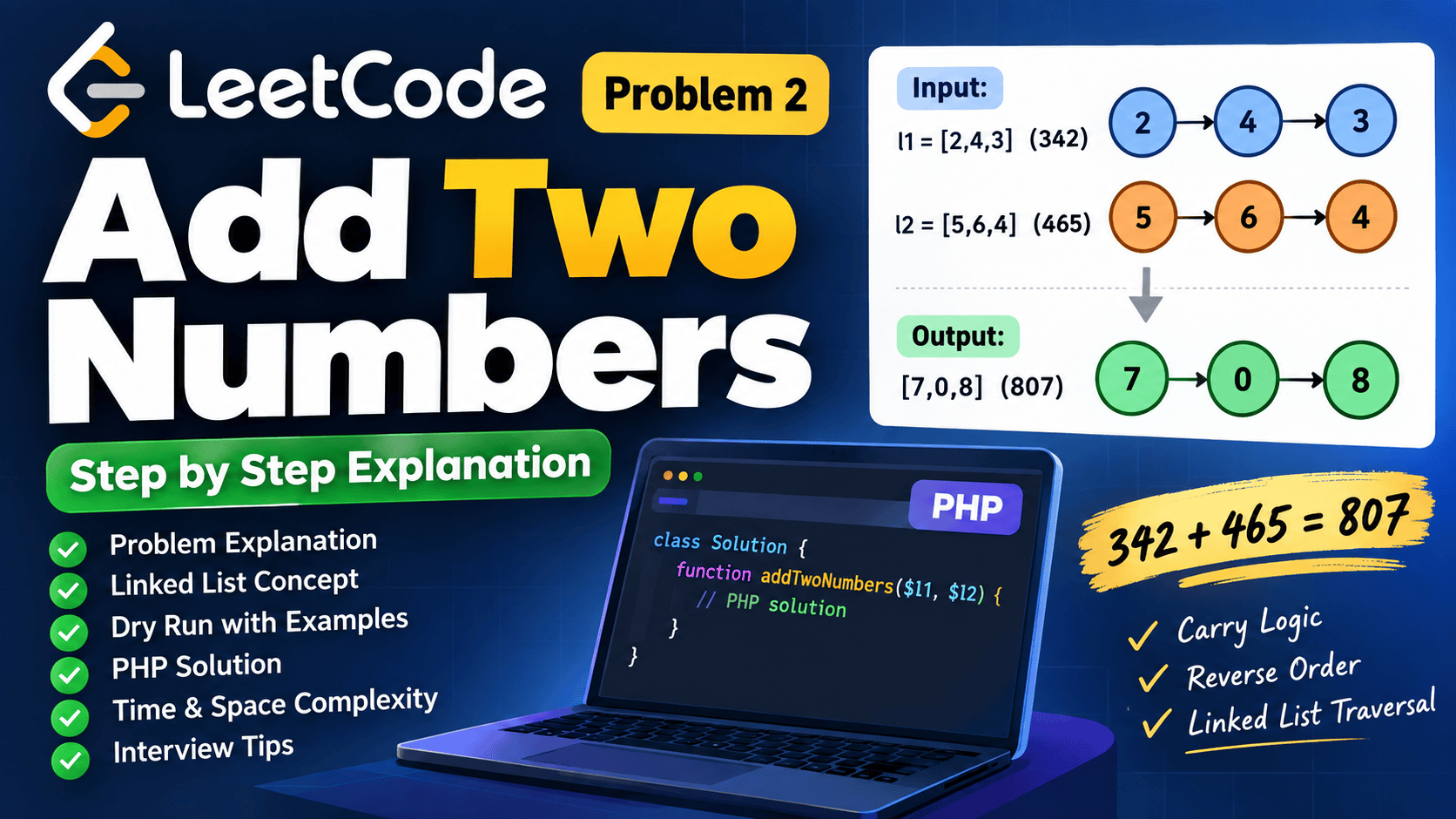
LeetCode 2: Add Two Numbers in PHP | Step-by-Step Solution
LeetCode Problem 2, Add Two Numbers, is a popular coding interview question that helps developers understand linked lists, arithmetic operations, and carry handling.
In this tutorial, we will solve the Add Two Numbers problem using PHP. We will explain the problem statement, understand linked lists, build the solution step by step, walk through a detailed dry run, and analyze the time and space complexity.
1. Problem Statement
You are given two non-empty linked lists representing two non-negative integers. The digits are stored in reverse order, and each node contains a single digit.
Your task is to add the two numbers and return their sum as a linked list.
You can assume that the numbers do not contain any leading zeros, except for the number 0 itself.
Example 1
Input:
l1 = [2,4,3]
l2 = [5,6,4]
Linked List Representation
First number:
Second number:
Output:
Explanation: The first linked list represents 342, and the second represents 465. Their sum is 807, which is stored in reverse order as [7,0,8].
Example 2
Input:
l1 = [0]
l2 = [0]

Output:
[0]
Explanation: 0 + 0 = 0.
Example 3
Input:
l1 = [9,9,9,9,9,9,9]
l2 = [9,9,9,9]

Output:
[8,9,9,9,0,0,0,1]
Explanation: The two linked lists represent 9,999,999 and 9,999. Their sum is 10,009,998, which is returned in reverse order.
2. Understanding a Linked List
A linked list is a linear data structure in which each element is stored in a node. Each node contains a value and a reference to the next node.
Unlike an array, linked list nodes do not have to be stored in consecutive memory locations. Each node points to the next node in the sequence.
Example of a singly linked list
Each circle represents a node. The arrow represents the next pointer, which connects the current node to the next node. NULL indicates the end of the linked list.
In this problem, each node contains one digit, and the digits are stored in reverse order. Therefore, [2,4,3] represents the number 342, not 243.
3. Understanding the Addition
Before writing the PHP code, let’s understand how normal addition works.
Consider adding 342 and 465:
Step 1: Add the units digits
2 + 5 = 7
Write 7 in the result. Carry = 0.
Step 2: Add the tens digits
4 + 6 = 10
Write 0 in the result and carry 1 to the next position.
Step 3: Add the hundreds digits
3 + 4 + 1 = 8
Write 8 in the result. Carry = 0.
Final result:
The main idea is to process the linked lists from beginning to end, add the digits at each position, and maintain a carry for the next position.
4. Approach to Solve the Problem
We can solve this problem efficiently using a simple traversal of both linked lists and a carry variable.
- Initialize a dummy node to serve as the starting point of the result linked list.
- Maintain a pointer called
currentto build the result. - Initialize
carry = 0. - Traverse both linked lists while either list has remaining nodes or a carry exists.
- Read the current digits from each list. If a list has ended, use 0 for that digit.
- Add both digits and the carry.
- Calculate the new digit using the modulo operator and update the carry using integer division.
- Create a new node for the resulting digit and append it to the result.
- Move the pointers to the next nodes and repeat until all digits and carry are processed.
- Return the next node of the dummy node as the final answer.
5. PHP Solution
LeetCode provides the ListNode class for this problem. The following is the complete solution that fits the LeetCode PHP editor.
class Solution {
    function addTwoNumbers($l1, $l2) {
        $dummy = new ListNode(0);
        $current = $dummy;
        $carry = 0;

        while ($l1 !== null || $l2 !== null || $carry > 0) {
            $sum = $carry;

            if ($l1 !== null) {
                $sum += $l1->val;
                $l1 = $l1->next;
            }

            if ($l2 !== null) {
                $sum += $l2->val;
                $l2 = $l2->next;
            }

            $carry = intdiv($sum, 10);
            $digit = $sum % 10;

            $current->next = new ListNode($digit);
            $current = $current->next;
        }

        return $dummy->next;
    }
}ListNode class in the LeetCode editor if it is already provided in the problem template. Submit only the Solution class.6. Explaining the PHP Code Line by Line
Step 1: Create a Dummy Node
$dummy = new ListNode(0);
$current = $dummy;
The dummy node is an initial placeholder for the result linked list. It simplifies the process of inserting the first digit because we do not need separate logic for the first node.
The current pointer tracks the last node in the result list, allowing us to append each new digit.
Step 2: Initialize Carry
$carry = 0;When adding two digits, their sum may be 10 or greater. The carry stores the extra value that needs to be added to the next digit position.
Step 3: Traverse Both Lists
while ($l1 !== null || $l2 !== null || $carry > 0) {
    $sum = $carry;
}
The loop continues while either linked list has a remaining node or there is a carry to process. This ensures that lists of different lengths and any final carry are handled correctly.
Step 4: Add the Current Digits
if ($l1 !== null) {
    $sum += $l1->val;
    $l1 = $l1->next;
}

if ($l2 !== null) {
    $sum += $l2->val;
    $l2 = $l2->next;
}
We add the values from both lists if the current nodes exist. If one list has ended, it contributes 0. Each pointer then advances to the next node.
Step 5: Calculate the Digit and Carry
$carry = intdiv($sum, 10);
$digit = $sum % 10;
We use intdiv() to get the integer quotient and the modulo operator to get the remainder.
$sum % 10gives the digit to store in the current result node.intdiv($sum, 10)gives the carry for the next position.
For example, if the sum is 15, the digit is 5 and the carry is 1.
Step 6: Create the Result Node
$current->next = new ListNode($digit);
$current = $current->next;
A new linked list node is created for the calculated digit and attached to the end of the result. The current pointer then advances to this newly created node.
Step 7: Return the Result
return $dummy->next;The dummy node is only a placeholder, so we return the node after it, which is the actual head of the resulting linked list.
7. Dry Run with Example
Let’s take the input:
l1 = [2,4,3]
l2 = [5,6,4]
These linked lists represent 342 and 465 respectively.
| Step | Digit 1 | Digit 2 | Carry In | Sum | Result Digit | Carry Out |
|---|---|---|---|---|---|---|
| 1 | 2 | 5 | 0 | 7 | 7 | 0 |
| 2 | 4 | 6 | 0 | 10 | 0 | 1 |
| 3 | 3 | 4 | 1 | 8 | 8 | 0 |
Step 1: Add 2 and 5
2 + 5 + 0 = 7. The result digit is 7, and the carry is 0.
Current result
Step 2: Add 4 and 6
4 + 6 + 0 = 10. The result digit is 0, and the carry is 1.
Current result
Step 3: Add 3 and 4 with Carry
3 + 4 + 1 = 8. The result digit is 8, and the carry becomes 0.
Final result
Output: [7,0,8]
The resulting linked list represents the number 807 when read in reverse order.
8. Handling Different Lengths
One linked list may contain more digits than the other. Our solution handles this by adding a digit only when its current node exists.
For example:
l1 = [9,9,9]
l2 = [1]
We calculate:
- 9 + 1 = 10 → digit 0, carry 1.
- 9 + 0 + 1 = 10 → digit 0, carry 1.
- 9 + 0 + 1 = 10 → digit 0, carry 1.
- Both lists have ended, but the carry remains 1, so we create one more node.
Final linked list
Output: [0,0,0,1], representing 1000.
9. Why Do We Use a Dummy Node?
A dummy node is a temporary starting node that simplifies linked list construction. Without it, we would need special handling to initialize the head when inserting the first result digit.
Using a dummy node means every result digit can be appended using the same logic. At the end, we return $dummy->next, skipping the placeholder.
10. Time and Space Complexity
Time Complexity: O(max(n, m))
Here, n is the number of nodes in the first linked list and m is the number of nodes in the second linked list.
The algorithm traverses each linked list once and processes one digit per iteration. Therefore, the time complexity is O(max(n, m)), with at most one extra iteration for a final carry.
Space Complexity: O(max(n, m))
The result is stored in a new linked list. In the worst case, the result may have one more digit than the longer input list because of a final carry. The auxiliary space is O(1) apart from the output linked list.
- Time Complexity: O(max(n, m))
- Auxiliary Space: O(1), excluding the result
- Output Space: O(max(n, m))
11. Common Mistakes to Avoid
- Reading digits in the wrong order: The linked lists store digits in reverse order, so traverse from the head.
- Forgetting the carry: Always add the carry from the previous position to the current sum.
- Assuming both lists have the same length: Check each pointer independently and use 0 when a list has ended.
- Ignoring the final carry: The loop must continue while the carry is greater than zero.
- Returning the dummy node: Return
$dummy->next, not the dummy node itself. - Converting the full linked list into an integer: Large inputs may exceed the native integer range. Perform digit-by-digit addition instead.
12. Frequently Asked Questions
LeetCode 2, Add Two Numbers, asks you to add two non-negative integers represented by linked lists in reverse digit order and return the result as a linked list.
Reverse order allows us to start adding from the units digit at the head of each linked list, just like normal arithmetic addition.
The time complexity is O(max(n, m)), where n and m are the lengths of the two input linked lists.
The carry stores the extra value when the sum of digits is 10 or more, so it can be added to the next position.
A dummy node simplifies the construction of the result linked list by eliminating the need for special handling of the first node.
Yes. Digit-by-digit addition directly on the linked lists avoids integer overflow and works efficiently even for long inputs.
When one list ends, the algorithm treats its missing digits as 0 while continuing to process the other list and any remaining carry.
13. Conclusion
LeetCode 2: Add Two Numbers is an excellent problem for understanding linked list traversal, arithmetic operations, and carry management.
By using a dummy node, two pointers, and a carry variable, we can build the resulting linked list in a single traversal without converting the entire numbers into integers.
- Linked lists represent numbers in reverse digit order.
- Process one digit from each list at a time.
- Maintain a carry to handle sums greater than 9.
- Use a dummy node to simplify result construction.
- Achieve O(max(n, m)) time complexity.
Practice this problem to strengthen your understanding of linked lists and prepare for technical coding interviews.