
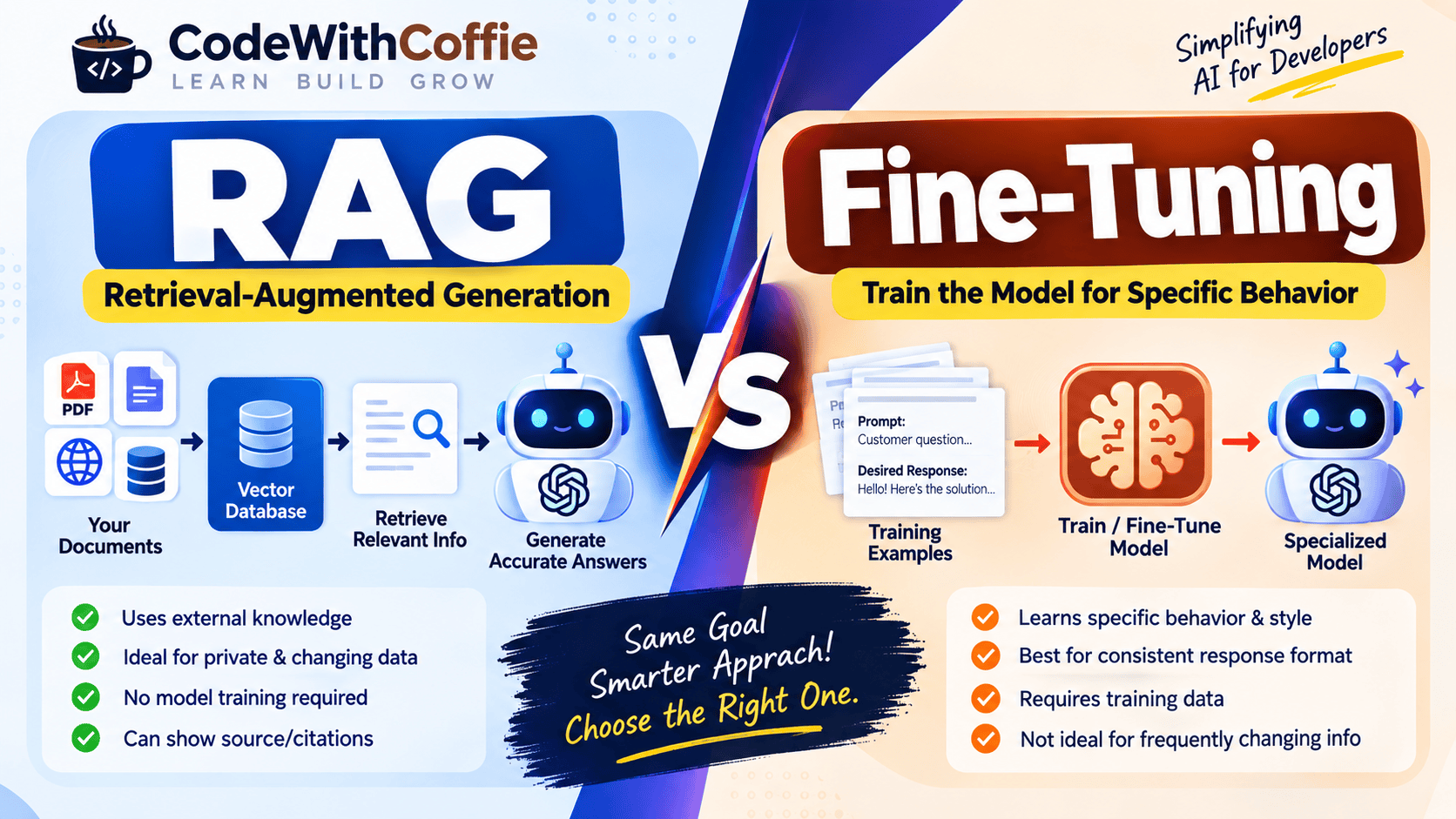
RAG vs Fine-Tuning: What is the Difference? Complete Guide
When building AI applications with Large Language Models (LLMs), two commonly discussed approaches are RAG (Retrieval-Augmented Generation) and Fine-Tuning.
Both can help customize an AI application, but they solve different problems.
If you want an AI model to answer questions using your company’s documents, PDFs, product documentation, or frequently changing information, RAG can be useful.
If you want an AI model to learn a particular response style, behavior, format, or specialized patterns from examples, fine-tuning may be more appropriate.
In this article, we will understand RAG vs Fine-Tuning, how both approaches work, their differences, advantages, limitations, use cases, and how to decide which approach fits your AI project.
What is RAG?
RAG stands for Retrieval-Augmented Generation.
RAG is an architecture that allows an AI application to retrieve relevant information from an external knowledge source before generating an answer.
Instead of depending only on the information contained in an LLM, the application searches a knowledge base and provides relevant information to the model as context.
A simplified RAG workflow looks like this:
User Question
      ↓
Search Knowledge Base
      ↓
Retrieve Relevant Information
      ↓
Send Context to LLM
      ↓
Generate AnswerFor example, suppose a company has thousands of pages of internal documentation.
A user asks:
What is our employee leave policy?The RAG system can:
- Search the company’s documents.
- Retrieve the relevant section.
- Give that information to the LLM.
- Generate an answer based on the retrieved content.
The model doesn’t need to memorize the entire company knowledge base.
What is Fine-Tuning?
Fine-tuning is the process of further training a pre-trained AI model on a specific dataset so that it becomes better suited to a particular task, style, or behavior.
A model already has general capabilities.
Fine-tuning exposes it to additional examples so that its behavior can be adapted.
For example, suppose you want an AI model to consistently generate customer support responses in a specific format.
Your training data might contain:
Customer:
My order has not arrived.

Desired Response:
Hello,
We are sorry for the delay.
Please provide your order ID so we can check the status.
Thank you.With enough suitable examples, fine-tuning can help the model learn the desired response patterns.
RAG vs Fine-Tuning: Simple Explanation
The easiest way to understand the difference is:
RAG gives the AI additional information.
Fine-tuning changes or specializes the model’s behavior.
Think about a developer.
RAG is like giving the developer access to your documentation while they are working.
Fine-tuning is more like training the developer to follow a particular way of solving or formatting tasks.
RAG vs Fine-Tuning Comparison
| Feature | RAG | Fine-Tuning |
|---|---|---|
| Main purpose | Retrieve external knowledge | Adapt model behavior |
| Uses external documents | Yes | Not directly at inference time |
| Good for private knowledge | Yes | Not the primary purpose |
| Good for changing information | Yes | Less suitable |
| Changes model weights | No | Yes |
| Requires training | Usually no model training | Yes |
| Knowledge updates | Update knowledge base | May require another training process |
| Response style customization | Limited | Strong |
| Source citations | Can be implemented | Not inherently provided |
| Initial complexity | Moderate | Moderate to high |
| Best for | Knowledge retrieval | Behavior/task specialization |
How RAG Works
Let’s understand the RAG process step by step.
Step 1: Collect Documents
The application collects information from sources such as:
- PDFs
- Websites
- Word documents
- FAQs
- Databases
- Product documentation
- Company policies
Step 2: Split Documents into Chunks
Large documents are divided into smaller sections.
Document
   ↓
Chunk 1
Chunk 2
Chunk 3
Chunk 4These chunks make it easier to retrieve relevant information.
Step 3: Generate Embeddings
Each chunk is converted into a numerical representation called an embedding.
Text
 ↓
Embedding
 ↓
VectorThe vector represents the semantic meaning of the text.
Step 4: Store Embeddings
Embeddings are stored in a vector database.
Examples include:
- Pinecone
- Qdrant
- Weaviate
- Chroma
- Milvus
- FAISS
Step 5: User Asks a Question
For example:
What is the refund policy?The question is also converted into an embedding.
Step 6: Retrieve Relevant Information
The system searches the vector database and retrieves the most relevant chunks.
Question
   ↓
Vector Search
   ↓
Relevant ChunksStep 7: Generate the Answer
The retrieved information is provided to the LLM.
Question
+
Retrieved Context
+
Instructions
       ↓
      LLM
       ↓
AnswerThis is RAG.
How Fine-Tuning Works
Fine-tuning follows a different process.
Step 1: Prepare Training Data
You create examples showing how the model should behave.
For example:
Input:
Explain a refund policy.

Output:
A customer can request a refund within 30 days...You need many high-quality examples for the task.
Step 2: Format the Dataset
The training examples are prepared in the format required by the chosen model and fine-tuning method.
Step 3: Train the Model
The model is trained further using the prepared dataset.
Conceptually:
Pre-trained Model
       ↓
Training Examples
       ↓
Fine-Tuning
       ↓
Specialized ModelStep 4: Use the Fine-Tuned Model
After training, the model can be used for the target task.
For example, a company might fine-tune a model to consistently produce responses in a particular format.
RAG Example
Imagine you have an e-commerce company.
Your knowledge base contains:
Shipping Policy

Standard delivery takes 5-7 business days.

Express delivery takes 2-3 business days.

Orders above ₹2,000 qualify for free standard shipping.A customer asks:
Will I get free shipping for a ₹2,500 order?The RAG system retrieves:
Orders above ₹2,000 qualify for free standard shipping.The LLM can then generate:
Yes. Your ₹2,500 order qualifies for free standard shipping.The important point is that the shipping information comes from the external knowledge base.
Fine-Tuning Example
Now imagine you operate a customer support system.
You want every response to follow a particular structure:
Greeting
Problem acknowledgement
Solution
Next step
ClosingYou have many examples of your preferred responses.
Fine-tuning can help the model learn this response pattern.
For example:
Customer:
My payment failed.

Model:
Hello,

We're sorry that your payment was unsuccessful.

Please try the payment again or use another payment method.

If the issue continues, please contact our support team.

Thank you.The focus here isn’t retrieving a specific document.
The focus is how the model responds.
RAG vs Fine-Tuning for Private Data
Suppose you have a company knowledge base containing:
10,000 PDF documentsand the information changes every month.
RAG is generally designed for this type of use case because the application can retrieve information from the current knowledge base.
You don’t necessarily need to retrain the model whenever a document changes.
For example:
New Document
     ↓
Process Document
     ↓
Create Embeddings
     ↓
Update Vector Database
     ↓
RAG can retrieve itRAG vs Fine-Tuning for Changing Information
This is one of the biggest differences.
Imagine your company changes its pricing:
Old Price:
₹999

New Price:
₹1,199With a RAG architecture, you can update the relevant information in your knowledge base.
With fine-tuning, changing knowledge can require updating the training data and performing another training process.
This is why fine-tuning is generally not the first choice simply for keeping frequently changing factual information current.
RAG vs Fine-Tuning for Response Style
Suppose you want your AI assistant to always respond in a particular style.
For example:
Professional
Short
Friendly
StructuredYou have many examples demonstrating this style.
Fine-tuning may be useful for adapting the model to these patterns.
RAG can provide information to the model, but retrieving information alone doesn’t necessarily teach the model a new communication style.
Does RAG Change the LLM?
No.
A standard RAG system does not modify the model’s weights.
Instead, it provides additional context during the request.
LLM
+
Retrieved Information
=
Context-Aware AnswerThe underlying model remains the same.
Does Fine-Tuning Change the Model?
Yes.
Fine-tuning modifies the model through additional training.
Conceptually:
Base Model
    ↓
Fine-Tuning Dataset
    ↓
Additional Training
    ↓
Adapted ModelThe resulting model is specialized toward the patterns represented in the training data.
RAG vs Fine-Tuning: Knowledge
This is an important distinction.
RAG
Useful for:
"Here is information. Use it to answer."Fine-Tuning
Useful for:
"Learn these patterns and behave this way."This simple distinction helps when deciding which architecture to use.
RAG vs Fine-Tuning: Cost
The cost depends heavily on the model, infrastructure, data size, retrieval architecture, usage volume, and training method.
However, the cost structure is different.
RAG
Typical components can include:
- Embedding generation
- Vector database
- LLM API calls
- Document processing
- Retrieval infrastructure
Fine-Tuning
Typical components can include:
- Training data preparation
- Training or fine-tuning charges
- Evaluation
- Model hosting or inference
- Dataset maintenance
For many applications, starting with RAG can be simpler when the primary requirement is access to external knowledge.
RAG vs Fine-Tuning: Accuracy
Neither approach automatically guarantees higher accuracy.
Accuracy depends on the problem.
For RAG, important factors include:
- Document quality
- Chunking strategy
- Embedding quality
- Retrieval quality
- Number of retrieved chunks
- Prompt design
- LLM quality
For fine-tuning, important factors include:
- Training data quality
- Dataset size
- Training configuration
- Evaluation methodology
- Base model
- Task definition
Therefore, the correct question isn’t simply:
“Which is more accurate?”
Instead, ask:
“Which approach matches the problem I am trying to solve?”
Can RAG and Fine-Tuning Be Used Together?
Yes.
RAG and fine-tuning are not mutually exclusive.
A system can use both.
For example:
User Question
      ↓
RAG Retrieval
      ↓
Relevant Company Information
      ↓
Fine-Tuned LLM
      ↓
Final ResponseIn this architecture:
- RAG provides relevant knowledge.
- Fine-tuning can help specialize the model’s behavior.
This can be useful when an application needs both domain knowledge retrieval and consistent specialized behavior.
When Should You Use RAG?
RAG is particularly useful when:
1. Your data changes frequently
Examples:
- Product prices
- Company policies
- Documentation
- FAQs
2. You have a large document collection
Examples:
- PDFs
- Manuals
- Research papers
- Internal documents
3. You need private knowledge
For example:
Company Documents
     ↓
Private Knowledge Base
     ↓
RAG
     ↓
AI Assistant4. You want document-based answers
For example:
Ask questions about:
PDF
DOCX
Website
Knowledge Base5. You want retrieval-based citations
A RAG system can be designed to show the source documents or passages used to construct an answer.
When Should You Use Fine-Tuning?
Fine-tuning can be considered when you need:
1. Specific response behavior
You want the model to consistently follow a particular behavior or output pattern.
2. Specific formatting
For example:
Input → JSON
Input → Structured output
Input → Classification3. Specialized task performance
If your application repeatedly performs a narrow task and you have a suitable dataset of examples, fine-tuning may be useful.
4. Consistent style
For example:
Brand voice
Customer support style
Specific writing styleWhen Should You Not Use RAG?
RAG may not be necessary when your application doesn’t need external knowledge retrieval.
For example, if the task is simply:
Convert this text into JSON.you may not need a vector database or retrieval pipeline.
Similarly, adding RAG to every AI application can introduce unnecessary complexity.
When Should You Not Use Fine-Tuning?
Fine-tuning may be unnecessary if your only goal is to give the model access to a changing knowledge base.
For example:
Company FAQ
Product documentation
Internal policiesIf the main requirement is retrieving this information, RAG may be a more direct approach.
RAG vs Fine-Tuning Decision Guide
You can use this simple decision process.
Question 1
Does the AI need access to external or private information?
If yes:
Consider RAGQuestion 2
Does the information change frequently?
If yes:
RAG is often a strong fitQuestion 3
Do you want to change how the model behaves or responds?
If yes:
Consider Fine-TuningQuestion 4
Do you need both external knowledge and specialized behavior?
If yes:
Consider RAG + Fine-TuningRAG + Fine-Tuning Architecture
A more advanced AI application might look like this:
                  User
                   │
                   ↓
              User Question
                   │
                   ↓
              RAG Retriever
                   │
                   ↓
            Vector Database
                   │
                   ↓
          Relevant Information
                   │
                   ↓
          Specialized LLM
                   │
                   ↓
             Final Answer
Here, each technology has a different responsibility.
RAG → Knowledge
Fine-Tuning → Behavior
LLM → Generation
RAG vs Fine-Tuning vs Prompt Engineering
There is actually another important technique: prompt engineering.
These three approaches can be understood as:
| Technique | Main Purpose |
|---|---|
| Prompt Engineering | Tell the model what to do |
| RAG | Give the model relevant external information |
| Fine-Tuning | Adapt model behavior through additional training |
For example:
Prompt:
Answer professionally.

RAG:
Here is the relevant company policy.

Fine-Tuning:
Learn our preferred response behavior.Real-World Example
Imagine you’re building an AI assistant for an online store.
The store has:
Product Catalog
Shipping Policy
Refund Policy
Customer FAQs
Company GuidelinesA good architecture could be:
                  User
                   ↓
                Question
                   ↓
             RAG Retrieval
                   ↓
          Product/Policy Data
                   ↓
           Specialized Model
                   ↓
              Final Answer
For example:
User:
Can I return this product after 20 days?RAG retrieves the refund policy.
The model then generates a response according to the desired customer-support format.
This is a practical example where RAG and model customization can complement each other.
Common Misconceptions
Misconception 1: RAG and Fine-Tuning are the Same
They aren’t.
RAG retrieves information.
Fine-tuning adapts model behavior through additional training.
Misconception 2: Fine-Tuning is the Best Way to Add Company Documents
Not necessarily.
If your primary requirement is access to company documents, RAG is often the more direct architecture.
Misconception 3: RAG Eliminates Hallucinations
No.
RAG can provide relevant context, but retrieval errors and generation errors can still occur.
Misconception 4: Fine-Tuning Gives the Model a Perfect Knowledge Base
Fine-tuning should not be treated as a database replacement.
If you need reliable access to changing documents, a retrieval system can be more appropriate.
Which One Should Beginners Learn First?
If you’re learning AI application development, a practical order is:
Python
   ↓
APIs
   ↓
LLM Basics
   ↓
Prompt Engineering
   ↓
Embeddings
   ↓
Vector Databases
   ↓
RAG
   ↓
Fine-TuningRAG is a particularly useful concept to learn because it teaches you how modern AI applications connect LLMs with external data.
After understanding RAG, you can move toward:
- Advanced retrieval
- Hybrid search
- Reranking
- Agents
- Evaluation
- Fine-tuning
- Production AI systems
Conclusion
RAG and Fine-Tuning are both important techniques for building AI applications, but they solve different problems.
RAG is primarily about giving an LLM access to relevant external information.
Fine-tuning is primarily about adapting a model’s behavior or performance for a specific task using additional training data.
A simple way to remember the difference is:
RAG
→ Give AI the right information.

Fine-Tuning
→ Teach AI how to behave.

Prompt Engineering
→ Tell AI what you want.And in advanced applications:
RAG + Fine-Tuning
→ Relevant knowledge + specialized behaviorThe right approach depends on your application’s requirements, data, update frequency, desired behavior, infrastructure, and evaluation results.
Is RAG better than fine-tuning?
Neither is universally better. RAG and fine-tuning are designed for different purposes. RAG focuses on retrieving external knowledge, while fine-tuning focuses on adapting model behavior through additional training.
Is RAG cheaper than fine-tuning?
The cost depends on the model, data volume, infrastructure, retrieval system, usage, and training requirements. RAG and fine-tuning also have different cost structures.
Can RAG replace fine-tuning?
Sometimes RAG can remove the need for fine-tuning when the main requirement is access to external knowledge. However, RAG does not replace fine-tuning for every use case.
Can I use RAG and fine-tuning together?
Yes. A system can use RAG for retrieving information and a customized model for specialized response behavior.
Is RAG used in ChatGPT?
RAG is a general AI architecture and is used in many AI applications. Specific products can use retrieval, search, tools, and other techniques in different ways.
What should I learn first, RAG or fine-tuning?
For developers building knowledge-based AI applications, learning embeddings, vector databases, and RAG first provides a useful foundation before moving into fine-tuning.