
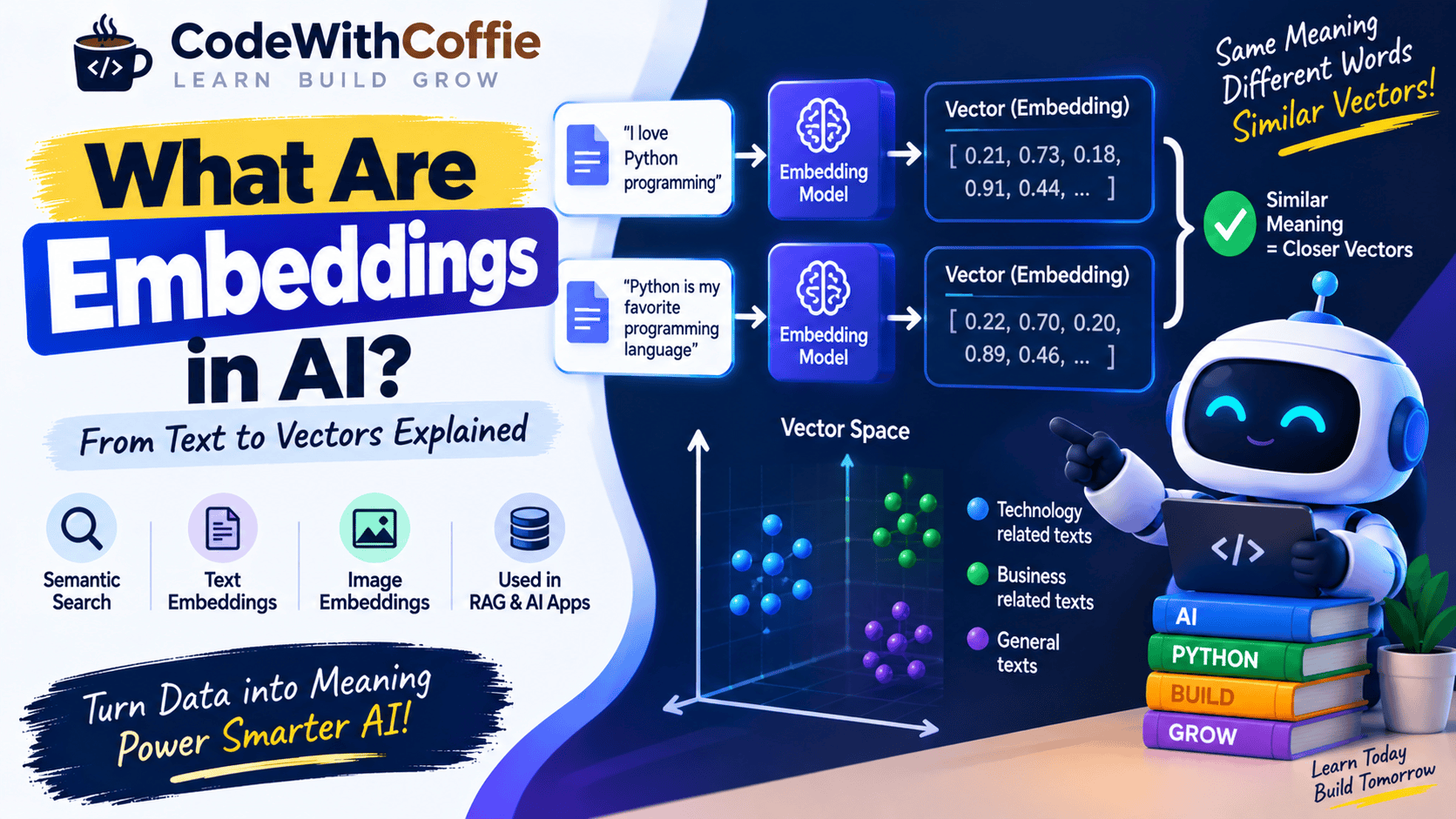
What are Embeddings in AI? Complete Guide with Examples
If you are learning Artificial Intelligence, Generative AI, RAG, Vector Databases, or Large Language Models (LLMs), you will often come across the term Embeddings.
Embeddings are one of the fundamental technologies behind modern AI applications. They allow computers to represent text, images, audio, and other types of data as numerical vectors that can be compared and searched.
For example, a computer does not naturally understand that:
“I forgot my password”
and
“How can I reset my password?”
have similar meanings.
An embedding model can convert these sentences into numerical representations where semantically similar content can be positioned close together in vector space.
In simple words:
An embedding is a numerical representation of data that captures useful semantic or feature information so that AI systems can compare and retrieve similar data.
What are Embeddings?
An embedding is a numerical representation of data.
An embedding model takes an input such as text, an image, or another type of data and converts it into a vector of numbers.
The basic process looks like this:
Input Data
    ↓
Embedding Model
    ↓
Numerical Vector
For example:
"I love Python programming"might be converted into something conceptually like:
[0.21, 0.73, 0.18, 0.91, 0.44, ...]The actual embedding may contain hundreds or thousands of numbers depending on the model.
These numbers are not meant to be interpreted individually by a human. Together, they represent useful characteristics of the input in a mathematical space.
Why are Embeddings Needed?
Computers are very good at processing numbers.
Human language, however, contains meaning, context, relationships, and concepts.
Consider these sentences:
I forgot my password.and:
How can I reset my password?The words are different, but the meaning is closely related.
A simple keyword search might not fully capture this relationship.
Embeddings allow the system to represent the semantic information mathematically.
Conceptually:
"I forgot my password."
          ↓
      Embedding
          ↓
[0.12, 0.83, 0.41, ...]and:
"How can I reset my password?"
          ↓
      Embedding
          ↓
[0.15, 0.80, 0.43, ...]These vectors can be compared to determine how similar the inputs are.
What is a Vector?
A vector is essentially a list of numbers.
For example:
[0.25, 0.71, 0.13, 0.88]This is a very small example.
Real-world embeddings can have many dimensions.
For example:
[0.12, 0.43, 0.91, 0.37, 0.52, ...]The number of dimensions depends on the embedding model.
A Vector Database can store these vectors and perform similarity searches over them.
Embedding vs Vector
These terms are often used interchangeably, but there is a useful distinction.
Embedding
An embedding is the representation produced by an embedding model.
Vector
A vector is the numerical structure used to represent that embedding.
For example:
Text
 ↓
Embedding Model
 ↓
Embedding
 ↓
Vector representationIn everyday AI development, people often simply call the resulting vector an “embedding.”
How Do Embeddings Work?
At a high level, the process is:
Input
  ↓
Embedding Model
  ↓
Numerical Representation
  ↓
Vector Space
  ↓
Similarity ComparisonLet’s take an example.
Suppose we have three sentences:
A: I love Python.
B: Python is my favorite programming language.
C: The weather is sunny today.An embedding model converts them into vectors.
Conceptually:
A → [0.21, 0.72, 0.18, ...]
B → [0.23, 0.69, 0.20, ...]
C → [0.81, 0.14, 0.91, ...]
A and B may be closer together because they have similar meanings.
C may be farther away because it talks about weather.
This is the basic idea behind semantic similarity.
What is Semantic Similarity?
Semantic similarity means similarity in meaning rather than simply similarity in words.
Consider:
Sentence 1:
How can I change my password?and:
Sentence 2:
I need to reset my account password.The wording is different, but the meaning is similar.
An embedding model can represent both sentences as vectors.
A similarity algorithm can then compare those vectors.
Sentence 1
     ↓
  Vector A
     ↘
      Similarity
     ↗
  Vector B
     ↑
Sentence 2This is one of the main reasons embeddings are useful for AI search applications.
Embeddings and Vector Databases
Embeddings and Vector Databases are closely related.
The typical workflow is:
Text
 ↓
Embedding Model
 ↓
Vector
 ↓
Vector DatabaseWhen a user searches:
User Question
 ↓
Embedding Model
 ↓
Query Vector
 ↓
Vector Database
 ↓
Similar Vectors
 ↓
Relevant InformationThe Vector Database stores the embeddings and makes similarity search efficient.
Embeddings in RAG
Embeddings play a critical role in RAG (Retrieval-Augmented Generation).
A basic RAG pipeline looks like this:
Documents
     ↓
Text Extraction
     ↓
Chunking
     ↓
Embeddings
     ↓
Vector DatabaseWhen the user asks a question:
User Question
     ↓
Query Embedding
     ↓
Vector Search
     ↓
Relevant Chunks
     ↓
LLM
     ↓
Final AnswerThe embeddings help the retrieval system find information that is semantically related to the user’s question.
Example: Embeddings in a RAG Application
Suppose you have this document:
Our refund policy allows customers
to request a refund within 30 days.The system splits the document into chunks and generates an embedding for each chunk.
Document Chunk
      ↓
Embedding Model
      ↓
Vector
      ↓
Vector DatabaseNow the user asks:
Can I get my money back after purchasing
the product?The question is converted into another embedding.
User Question
      ↓
Embedding Model
      ↓
Query VectorThe Vector Database compares the query vector with stored vectors.
It finds the refund policy because the meanings are related.
The retrieved text is then sent to the LLM.
Retrieved Context
+
User Question
      ↓
     LLM
      ↓
Final AnswerWhat are Text Embeddings?
Text embeddings represent text as numerical vectors.
They can be generated for:
- Words
- Sentences
- Paragraphs
- Documents
- Search queries
- Product descriptions
- FAQs
For example:
"Python tutorial for beginners"can be converted into an embedding.
Another sentence:
"Learn Python from scratch"may have a similar semantic representation.
Text embeddings are widely used for:
- Semantic search
- RAG
- Recommendation systems
- Document classification
- Duplicate detection
- Clustering
What are Sentence Embeddings?
Sentence embeddings are embeddings representing the meaning of an entire sentence.
For example:
"How do I create a Python API?"can be converted into a vector representing the semantic content of that sentence.
This makes sentence embeddings useful for comparing questions, documents, and other text.
What are Document Embeddings?
Long documents can also be represented using embeddings.
However, in RAG applications, documents are often divided into smaller chunks before embeddings are generated.
For example:
Large Document
      ↓
Chunk 1
Chunk 2
Chunk 3
Chunk 4
      ↓
Embedding for each chunkThis makes it easier to retrieve the specific part of the document that is relevant to a user’s question.
What are Image Embeddings?
Embeddings aren’t limited to text.
Images can also be converted into numerical representations.
For example:
Image
  ↓
Image Embedding Model
  ↓
VectorThe resulting vectors can be used for tasks such as:
- Image similarity search
- Visual search
- Recommendation systems
- Image clustering
- Duplicate image detection
For example, an application could search for images visually similar to a given image.
What are Multimodal Embeddings?
Some embedding systems can represent different types of data in a shared or comparable embedding space.
For example:
Text
 ↓
Embedding

Image
 ↓
EmbeddingDepending on the model, text and images may be represented in a way that allows cross-modal comparisons.
This can enable applications such as:
Search using text
       ↓
Find related imagesor:
Image
 ↓
Find similar text descriptionsWhat is an Embedding Model?
An embedding model is a machine learning model designed to convert input data into numerical vectors.
For text:
Text
 ↓
Embedding Model
 ↓
VectorDifferent embedding models have different:
- Dimensions
- Performance characteristics
- Languages supported
- Cost
- Speed
- Domain strengths
The choice of embedding model can have a significant effect on retrieval quality.
What is Vector Similarity?
Once two pieces of data have been converted into vectors, we need a way to compare them.
Common similarity or distance measures include:
- Cosine similarity
- Dot product
- Euclidean distance
These methods help determine how close or similar two vectors are.
Cosine Similarity
Cosine similarity is one of the most commonly discussed methods for comparing embeddings.
It measures the cosine of the angle between two vectors.
Conceptually:
Vector A
   ↘
    ↘
     ↘
Vector BIf the vectors point in similar directions, their cosine similarity is generally higher.
For example:
A:
How do I reset my password?

B:
I forgot my password.These two sentences have related meanings, so their embeddings may have high similarity.
Euclidean Distance
Euclidean distance measures the straight-line distance between two points in vector space.
Conceptually:
Point A ●────────● Point BA smaller distance means the vectors are closer according to this metric.
It can be useful for certain embedding and search applications, although the best metric depends on the embedding model and system design.
Dot Product
The dot product is another way to compare vectors.
It combines corresponding vector components to produce a numerical score.
Vector search systems can use dot product as a similarity measure when the embedding model and indexing setup are designed for it.
What Determines Embedding Quality?
Several factors can influence embedding quality.
1. Embedding Model
Different models produce different representations.
2. Input Quality
Poor-quality text can produce poor retrieval results.
3. Chunking
For document retrieval, the way documents are divided into chunks matters.
4. Domain
An embedding model that performs well for general text may not perform equally well for every specialized domain.
5. Language
Different embedding models have different multilingual capabilities.
Why is Chunking Important for Embeddings?
Imagine you have a 100-page PDF.
You probably don’t want to create one embedding for the entire document and expect it to answer every question accurately.
Instead, you can split the document into meaningful chunks:
100-page PDF
      ↓
Chunk 1
Chunk 2
Chunk 3
...
Chunk 100Each chunk gets its own embedding.
When a user asks a question, the system can retrieve the most relevant chunks.
Good chunking can improve retrieval quality.
Embeddings vs Keywords
Let’s compare them.
Keyword Search
Query:
Python APIThe search system focuses heavily on matching terms.
Embedding Search
Query:
How can I build an API using Python?The system can retrieve content about:
Python REST API
FastAPI
Building APIs with Python
Python backend developmenteven when the exact wording differs.
This is why embeddings are powerful for semantic search.
Real-World Uses of Embeddings
Embeddings are used in many AI applications.
1. Semantic Search
Users can search using natural language rather than exact keywords.
2. RAG
Embeddings help retrieve relevant document chunks before sending them to an LLM.
3. Recommendation Systems
Products, articles, videos, or other content can be represented as vectors.
Similar items can then be discovered.
4. Duplicate Detection
Embeddings can help identify text or content that is semantically similar.
5. Document Classification
Documents can be represented as vectors and used as part of classification systems.
6. Clustering
Similar documents or pieces of content can be grouped together.
For example:
Python Articles
       ↓
Cluster 1

Laravel Articles
       ↓
Cluster 2

AI Articles
       ↓
Cluster 37. Recommendation Engines
Suppose a user reads several AI articles.
The system can represent those articles using embeddings and find other semantically similar content.
8. Image Search
Image embeddings can be used to find visually similar images.
Embeddings in an AI Chatbot
Imagine building an AI chatbot for a company.
The company has:
FAQs
Product Documentation
Support Articles
Policies
User GuidesThe process can be:
Documents
   ↓
Chunking
   ↓
Embeddings
   ↓
Vector DatabaseWhen a user asks:
How can I cancel my subscription?the application creates an embedding for the question.
Question
   ↓
Query Embedding
   ↓
Vector Search
   ↓
Relevant DocumentsThe retrieved information is then provided to the LLM.
Relevant Context
+
Question
 ↓
LLM
 ↓
AnswerEmbeddings vs LLMs
Embeddings and LLMs are related to AI, but they have different purposes.
Embedding Model
Main purpose:
Data
 ↓
Vector RepresentationLLM
Main purpose:
Prompt + Context
 ↓
Generated ResponseFor example:
Document
   ↓
Embedding Model
   ↓
Vector Database
   ↓
Retrieve Information
   ↓
LLM
   ↓
AnswerThey can work together in a RAG application.
Embeddings vs Vector Database
These two concepts are also different.
Embedding
Converts data into a vector.
Text
 ↓
Embedding
 ↓
VectorVector Database
Stores and searches vectors.
Vector
 ↓
Vector Database
 ↓
Similarity SearchSo:
Embedding creates the representation. Vector Database stores and retrieves the representation.
Can Embeddings Be Stored in MySQL?
Depending on your database version and setup, vector data and vector search capabilities may be available in some relational database systems.
However, dedicated Vector Databases are specifically designed around vector search workloads and may provide specialized indexing, filtering, and retrieval features.
For a production application, the choice depends on:
- Dataset size
- Search requirements
- Existing infrastructure
- Latency requirements
- Operational complexity
- Cost
Embeddings and Metadata
An embedding is often stored together with metadata.
For example:
Vector:
[0.21, 0.73, 0.18, ...]
Metadata:
{
"title": "Python API Tutorial",
"category": "Python",
"author": "CodeWithCoffie",
"page": 10
}This allows the application to combine semantic search with filters.
For example:
Search:
Python API tutorials
Filter:
category = PythonEmbedding Pipeline
A typical document embedding pipeline looks like this:
Document
↓
Text Extraction
↓
Chunking
↓
Embedding Model
↓
Vectors
↓
Vector Database
Query pipeline:
User Query
↓
Embedding Model
↓
Query Vector
↓
Similarity Search
↓
Relevant Text Chunks
RAG pipeline:
Relevant Chunks
+
User Question
↓
LLM
↓
Generated AnswerCommon Mistakes When Using Embeddings
1. Choosing an Embedding Model Without Testing
Different models perform differently on different datasets.
Always evaluate retrieval quality for your actual use case.
2. Poor Chunking
Very large or very small chunks can both create retrieval problems depending on the content.
3. Ignoring Metadata
Metadata filters can significantly improve retrieval in many applications.
4. Assuming Similarity Means Correctness
A highly similar result is not automatically the correct answer.
Retrieval should be evaluated against real queries.
5. Using Embeddings Without Understanding Retrieval
Embeddings are only one part of a retrieval pipeline.
A complete system may also require:
- Chunking
- Indexing
- Metadata filtering
- Hybrid search
- Reranking
- Query transformation
- Evaluation
A Simple Embedding Example
Imagine your knowledge base contains:
Document 1:
Python is used for web development and AI.
Document 2:
Laravel is a PHP framework for web applications.
Document 3:
React is a JavaScript library for building user interfaces.A user asks:
Which technology can I use for AI development?The query is converted into an embedding.
The system compares it with document embeddings.
Conceptually:
Query
↓
Embedding
↓
Similarity Search
↓
Document 1The application retrieves Document 1 because it is semantically related to the query.
Are Embeddings the Same as AI Memory?
Not exactly.
Embeddings are numerical representations used for tasks such as:
- Similarity search
- Retrieval
- Classification
- Clustering
- Recommendation
They can be part of an AI memory architecture, but an embedding itself is not “memory.”
A memory system usually includes additional storage, retrieval, and logic around the embeddings.
How to Learn Embeddings as a Developer
If you are learning AI development with Python, follow this path:
Step 1: Learn Python
Understand:
- Variables
- Functions
- Lists
- Dictionaries
- Classes
- File handling
- APIs
Step 2: Learn AI Basics
Understand:
- Machine Learning basics
- Neural networks
- LLMs
- Tokens
- Prompts
- Context windows
Step 3: Learn Embeddings
Learn:
- What embeddings are
- Text embeddings
- Vector representations
- Dimensions
- Similarity
Step 4: Learn Vector Search
Understand:
- Cosine similarity
- Dot product
- Euclidean distance
- Nearest-neighbor search
Step 5: Learn Vector Databases
Explore technologies such as:
- Qdrant
- Pinecone
- Weaviate
- Chroma
- Milvus
- FAISS
Step 6: Build a RAG Project
Build a simple:
PDF Question Answering System
PDF
↓
Text Extraction
↓
Chunking
↓
Embeddings
↓
Vector Database
↓
User Question
↓
Query Embedding
↓
Similarity Search
↓
Relevant Chunks
↓
LLM
↓
AnswerThis project will help you understand how embeddings work in a real AI application.
Frequently Asked Questions
What are embeddings in AI?
Embeddings are numerical representations of data that capture useful semantic or feature information and allow AI systems to compare and retrieve similar content.
What are embeddings in simple words?
Embeddings convert information such as text or images into numbers so that computers can compare relationships and similarities mathematically.
Why are embeddings used in RAG?
Embeddings allow a RAG system to convert documents and user queries into vectors and retrieve relevant information based on semantic similarity.
What is the difference between embeddings and vectors?
An embedding is the representation generated by an embedding model, while a vector is the numerical structure used to represent that embedding. In AI development, the terms are often used interchangeably.
What is an embedding model?
An embedding model converts input data into numerical vector representations.
Are embeddings only used for text?
No. Embeddings can also represent images, audio, code, and other types of data, depending on the model.
What is the relationship between embeddings and Vector Databases?
The embedding model creates vectors, while the Vector Database stores and searches those vectors.
Data
↓
Embedding Model
↓
Vector
 ↓
Vector Database
 ↓
Similarity SearchAre embeddings used by ChatGPT?
Embedding technology is widely used across modern AI systems for tasks such as search, retrieval, recommendations, and other applications. The exact architecture of a particular product can vary.
Can embeddings reduce AI hallucinations?
Embeddings themselves do not prevent hallucinations. In a RAG system, good embeddings can improve retrieval quality, which can help provide more relevant context to an LLM. However, hallucinations can still occur.
Conclusion
Embeddings are a fundamental technology behind many modern AI applications.
They convert data such as text or images into numerical vector representations, making it possible for AI systems to compare data based on semantic or feature similarity.
The basic process is:
Data
 ↓
Embedding Model
 ↓
Vector
 ↓
Vector Search
 ↓
Relevant Information
In a RAG application, embeddings connect your documents to the retrieval system:
Documents
 ↓
Chunks
 ↓
Embeddings
 ↓
Vector Database
 ↓
Similarity Search
 ↓
Relevant Context
 ↓
LLM
 ↓
Answer
Understanding embeddings is therefore an important step before learning advanced topics such as RAG, Vector Databases, semantic search, hybrid search, reranking, and AI agents.