
What is memory management in PHP?
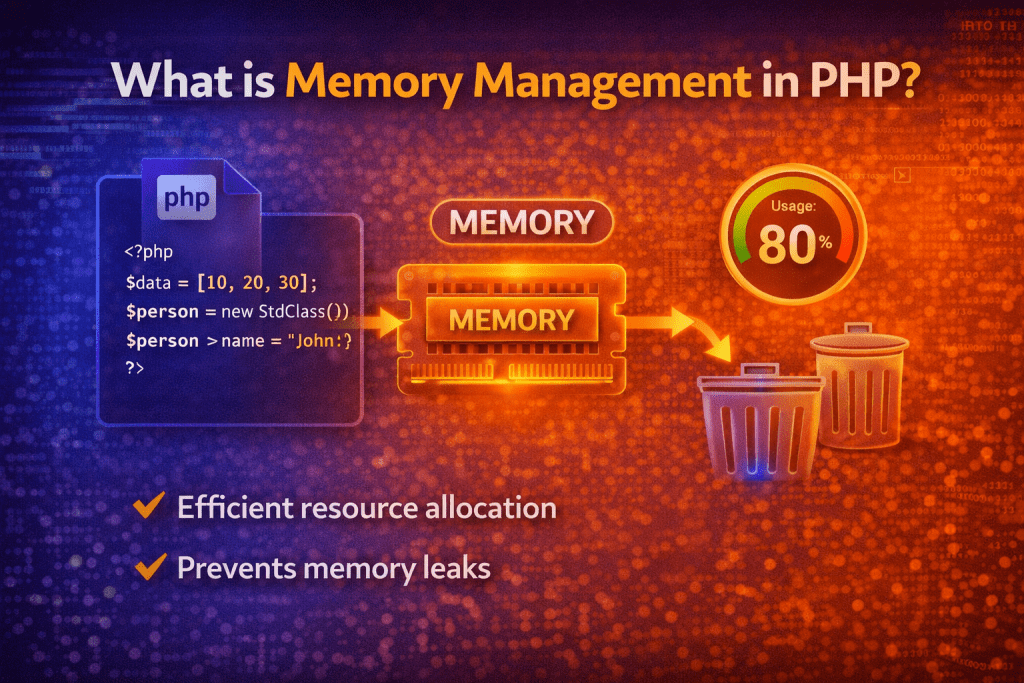
Memory Management in PHP refers to how PHP allocates, uses, and frees memory during the execution of a script. It ensures your application runs efficiently without wasting resources.
📌 Simple Definition
👉 Memory management is the process of handling memory allocation and deallocation automatically in PHP.
⚙️ How Memory Management Works in PHP
PHP automatically handles memory using:
- 🧠 Zend Engine (core of PHP)
- ♻️ Garbage Collection (GC)
- 📦 Reference Counting
🔍 Key Concepts
1️⃣ Memory Allocation
When you create variables, PHP allocates memory:
$a = "Hello";
👉 Memory is assigned to store "Hello".
2️⃣ Reference Counting
PHP tracks how many variables are using the same value.
$a = "PHP";
$b = $a;
👉 Both $a and $b point to the same memory.
3️⃣ Garbage Collection (GC)
When a variable is no longer used, PHP frees memory automatically.
unset($a);
👉 Memory is released if no references remain.
4️⃣ Circular Reference Problem
Sometimes objects reference each other:
class A {
    public $ref;
}$a = new A();
$b = new A();$a->ref = $b;
$b->ref = $a;
👉 PHP’s Garbage Collector detects and cleans this.
📊 Memory Functions in PHP
🔹 Check Memory Usage
echo memory_get_usage();
🔹 Peak Memory Usage
echo memory_get_peak_usage();
🔹 Set Memory Limit
ini_set("memory_limit", "256M");
🚀 Why Memory Management is Important
- ⚡ Improves performance
- 📉 Prevents memory leaks
- 🚫 Avoids “Allowed memory size exhausted” error
- 🧠 Efficient resource usage
💡 Real-Life Example
👉 Large data processing:
$data = range(1, 1000000);
Without proper memory handling → ❌ High memory usage
With optimization → ✅ Better performance
⚠️ Common Issues
- ❌ Memory leaks (unused variables not cleared)
- ❌ Large arrays/objects
- ❌ Infinite loops consuming memory
🛠 Best Practices
- Use
unset()for large variables - Avoid unnecessary copies of data
- Use generators (
yield) for large datasets - Optimize loops and queries
- Monitor memory usage regularly
🔄 Generators Example (Memory Efficient)
function numbers() {
    for ($i = 1; $i <= 1000000; $i++) {
        yield $i;
    }
}foreach (numbers() as $num) {
    echo $num;
}
👉 Uses less memory compared to arrays ✅
🎯 Conclusion
Memory management in PHP is mostly automatic, but understanding it helps you build high-performance and scalable applications. By managing memory properly, you can avoid errors and improve efficiency.