
How to traverse the DOM?
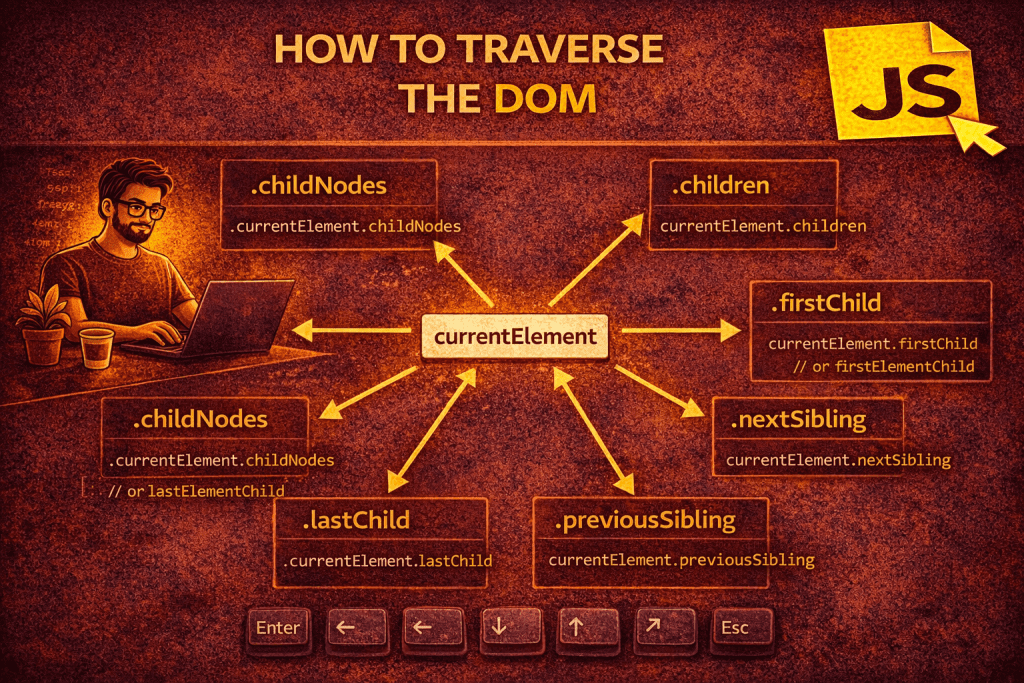
In JavaScript, traversing the DOM means moving through the DOM tree to access parent, child, and sibling elements relative to a given node.
Here are the main ways to traverse the DOM:
1. Parent Traversal
element.parentNode→ Gets the parent node (can be an element, text, or document).element.parentElement→ Gets the parent element (only if it’s an element).
let child = document.querySelector(".child");
console.log(child.parentNode);     // parent node
console.log(child.parentElement);  // parent element
2. Child Traversal
element.childNodes→ Returns all child nodes (including text and comments).element.children→ Returns only element children (HTMLCollection).element.firstChild/element.lastChild→ First/last node (could be text).element.firstElementChild/element.lastElementChild→ First/last element.
let parent = document.querySelector(".parent");
console.log(parent.children);              // only element children
console.log(parent.firstElementChild);     // first element child
console.log(parent.lastElementChild);      // last element child
3. Sibling Traversal
element.nextSibling/element.previousSibling→ Any node.element.nextElementSibling/element.previousElementSibling→ Only element siblings.
let item = document.querySelector(".item");
console.log(item.nextElementSibling);     // next element sibling
console.log(item.previousElementSibling); // previous element sibling
4. Other Useful Traversals
element.closest(selector)→ Finds the nearest ancestor that matches a selector.element.querySelector(selector)→ Finds the first matching descendant.element.querySelectorAll(selector)→ Finds all matching descendants.
let btn = document.querySelector(".btn");
console.log(btn.closest(".container")); // nearest ancestor with class "container"
✅ Summary:
- Up:
parentNode,parentElement,closest() - Down:
children,firstElementChild,lastElementChild,querySelector - Sideways:
nextElementSibling,previousElementSibling
No comments yet! You be the first to comment.